Some UFO cases are strong because the witness is unimpeachable. JAL 1628 is interesting for the opposite reason: the main witness was a seasoned airline captain whose later behaviour complicated his own testimony, the corroborating radar was genuinely ambiguous, and there were two very bright objects hanging in the sky that night that had nothing to do with UFOs. It is a case that rewards being read slowly, because almost every dramatic element has a sober counterpart sitting right beside it.
Lights over the Arctic
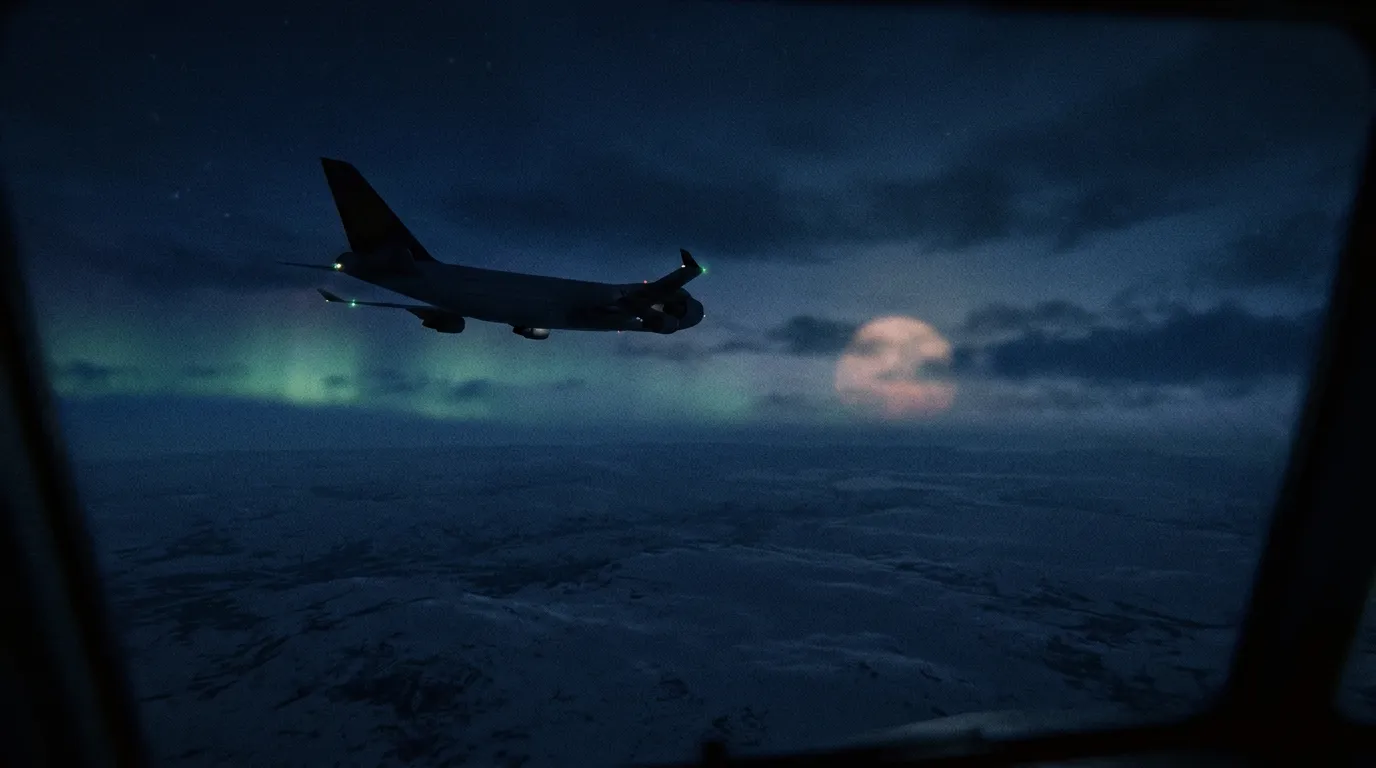
On the evening of 17 November 1986, Japan Air Lines Flight 1628 — a Boeing 747 freighter on a cargo run from Paris to Tokyo — was crossing eastern Alaska on the leg into Anchorage. In the left-hand seat was Captain Kenju Terauchi, a former military pilot with more than 10,000 hours. Beside him sat co-pilot Takanori Tamefuji; behind them, flight engineer Yoshio Tsukuba.
At 5.09pm Alaska time the Anchorage Air Route Traffic Control Center called the aircraft, then about 104 miles north-east of Fort Yukon, and asked for a heading change to route it south of Fort Yukon and Fairbanks. Tamefuji turned the aircraft roughly fifteen degrees left. Two minutes later, at around 35,000 feet, Terauchi noticed lights out of his side window, off to the left and below.
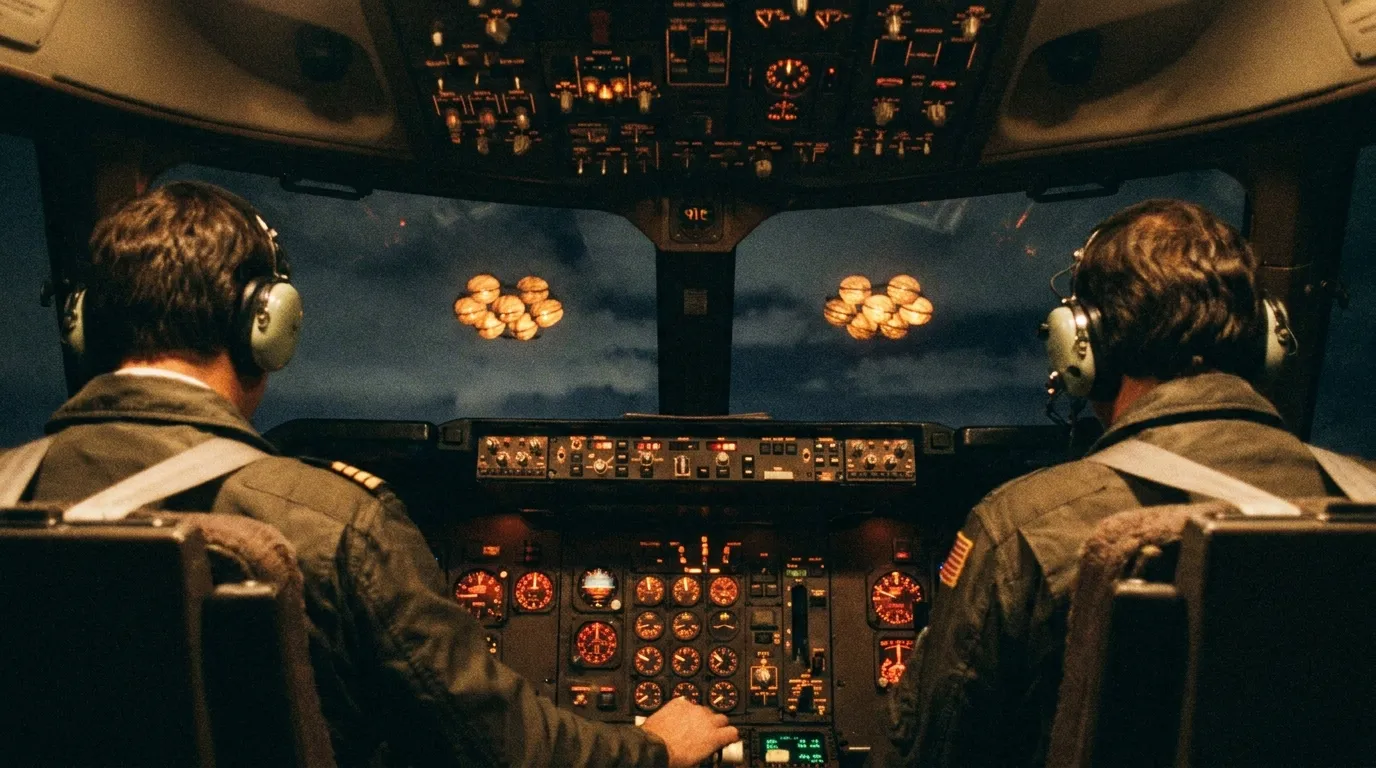
At first the crew described two smaller objects, each an array of lights, moving with a precision and a suddenness that unsettled them. This went on not for seconds but for many minutes — long enough to rule out a fleeting misperception, and long enough for the crew to become genuinely alarmed. All three men on the flight deck reported seeing them.
The thing the size of a ship
At around 5.19pm, according to Terauchi, it escalated. Behind and above the smaller lights, he said, loomed a gigantic object — pale, dimly lit, which he characterised as walnut-shaped, and which he would later describe as larger than an aircraft carrier: a vast silhouette pacing the 747 across the dark wilderness.
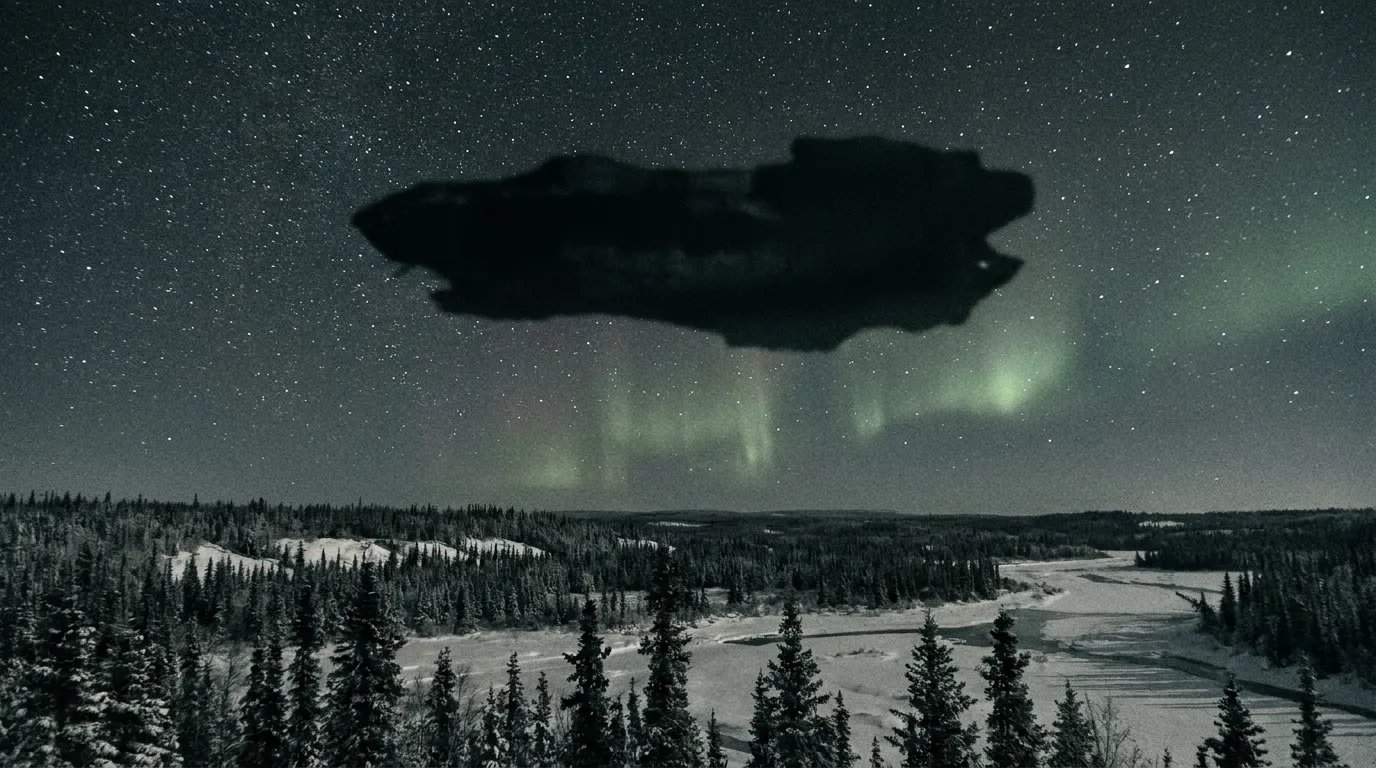
It is worth noting where the mothership sits in the evidence. The two clusters of lights are reported by all three crew members. The enormous silhouette behind them is essentially Terauchi’s, and it grows in his own telling: the written report he filed and the drawings he produced afterwards are considerably more elaborate than what went over the radio at the time. That is not proof of anything, but it is the kind of drift that ought to be recorded rather than smoothed over.
What the radar did and didn’t show
The crew asked air traffic control and their own set for confirmation, and here the case both gains and loses its footing.
Anchorage centre did see something intermittently near the 747, and at points the aircraft’s own weather radar registered a return. But the returns were not continuous, and they did not behave like a clean, independent target. Anchorage asked a United Airlines flight in the area and a military aircraft to take a look for unusual traffic near JAL 1628. Neither reported seeing anything.
The controllers also gave Terauchi an unusually direct instruction: take evasive action. He descended and flew a full circle. By his account the lights were still with him afterwards — which is either extraordinary, or exactly what you would expect if the light source were effectively at infinity.
The encounter as a whole ran for roughly fifty minutes, ending as the aircraft approached Anchorage. The disputed radar covers rather less of that than the story usually implies.
The FAA’s quiet unease
What keeps JAL 1628 respectable is that the FAA took it seriously. The agency retained the radar data, the voice tapes and the crew statements — an unusually complete record for a sighting of any kind, and one that is now largely in the public domain.
The most quoted insider is John Callahan, who in 1986 was the FAA’s Division Chief for Accidents, Evaluations and Investigations, and who went public in 2001. Callahan’s account is that he took the material to Washington, that a briefing was held the following day for the FAA Administrator, Admiral Donald Engen, attended by representatives of the FBI, the CIA and President Reagan’s scientific study team — and that at the end of it the CIA attendees told the room the meeting had never taken place and the incident had never been recorded.
Weigh that as what it is: a first-hand recollection, given fifteen years after the fact, of a classified conversation with no independent corroboration. Callahan’s FAA seniority is real and has been confirmed; the “this meeting never happened” scene rests on his word alone. Both of those statements are true at once, and a fair account has to carry both.
The official finding: a split radar image
The FAA’s public conclusion, by contrast, is fully documented and rather deflating.
After a three-month investigation, the agency presented its findings at a press conference on 5 March 1987. Paul Steucke, the FAA’s public information officer in Anchorage, walked back earlier suggestions that FAA controllers had confirmed a UFO, and attributed the return near the 747 to a split radar image — a known artefact in which a single aircraft’s echo separates into two on the scope, arriving in this instance with spectacularly unfortunate timing. Returns on military radar were assessed as clutter.
Steucke’s summary was careful and, to the agency’s credit, not dismissive of the crew: the FAA did not have enough material to confirm that something was there, it accepted the crew’s descriptions of what they had seen, and it was unable to support what they saw. That is the official finding of record, and it has never been reversed.
The two lights in the wrong place
Now the cold water, and it is specific. On that night, from JAL 1628’s position and heading, the planets Jupiter and Mars were shining brilliantly, low in the sky, in very nearly the direction the crew first reported the pacing lights. Bright planets seen from a moving aircraft, refracted and smeared through cold, layered Arctic air, are a documented cause of exactly this kind of “it’s keeping pace with us” illusion — because a distant object appears not to move relative to you as you fly.
This is Philip Klass’s case, set out in the Skeptical Inquirer in the summer of 1987 under the title “FAA Data Sheds New Light on JAL Pilot’s UFO Report”. Klass established that Jupiter was blazing in almost exactly the reported direction, with Mars some twenty degrees to its right and dimmer — two lights, side by side, in the right place at the right time. He later offered a supplementary explanation for the larger object: moonlight reflecting from turbulent ice crystals and cloud, which would also account for lights that flared and faded as conditions changed.
The obvious objection to Klass is that Terauchi, an experienced pilot who flew Arctic routes, never reported seeing Jupiter or Mars as well as the lights — and a planet does not stop being visible because something else is. That is a real weakness in the planetary account, and sceptics tend to slide past it. James Oberg, the former NASA engineer who has spent decades on spaceflight-related misidentifications, argued the broader point that the whole sequence is consistent with atmospheric optics and sensor artefacts rather than a solid object.
What happened to the captain
The aftermath is the part of this case with the longest reach, and it has nothing to do with what was in the sky.
Terauchi talked to the press. Japan Air Lines grounded him and moved him to a desk job — a decision widely read as punishment for the embarrassment rather than any doubt about his flying. He was reinstated some years later and continued his career; he died in 2019. He also reported further sightings afterwards, which led even sympathetic investigators to weigh his testimony with more care than they might otherwise have done.
The signal to every other airline pilot was unambiguous, and it took decades to undo. That reporting culture is only now shifting, which is a large part of why commercial crews have started filing again in numbers — and why the far more mundane question of how long the FAA actually keeps its radar data has become the live one.
The UAP Times take
JAL 1628 earns a Credible rating, four out of five on our scale, and it is a genuinely finely balanced case. In its favour: a professional three-man crew who all saw the initial lights, a long-duration encounter, a preserved documentary record, and an FAA that engaged rather than dismissed. Against it: an investigating agency that examined its own radar and concluded the return was a split image, a lead witness whose account grew in the retelling and whose later record muddied the water, and two of the brightest objects in the night sky sitting almost exactly where the encounter began.
The FAA never said nothing happened. It said it could not support what the crew saw — which is a different, and more honest, sentence.
Our reading is that JAL 1628 is very likely a planet-and-ice-fog case that grew, over a tense hour in the dark, into something enormous — the human perceptual system doing what it does when a trained but frightened observer stares at a brilliant, unmoving light from a moving cockpit. “Very likely” is not “certainly,” and Klass’s failure to explain why nobody on that flight deck also noticed Jupiter is the loose thread that keeps the case on the list.
What JAL 1628 really earns its place for is as a control. It is the clearest example in this file of how a real, documented, professionally-witnessed event can still have an entirely earthbound cause — the mirror image of the Nimitz Tic Tac, where the cross-sensor data stubbornly resists any such tidy explanation. Any framework that cannot tell those two cases apart is not a framework worth having.
Further reading: for a radar case that holds up far better than this one’s did, see The Tehran Dogfight. For what happened to pilot reporting after captains watched Terauchi lose his flight deck, see the commercial-pilot reporting surge. The JAL crew described classic bright orbs and a cigar-like mothership; the case is on the sightings map.
Source: FAA investigation records; crew testimony; analyses by James Oberg and Philip Klass
Follow the file
Every new dispatch from the UAP desk, in your inbox. Sourced, sceptical, and no more than one email a week.