
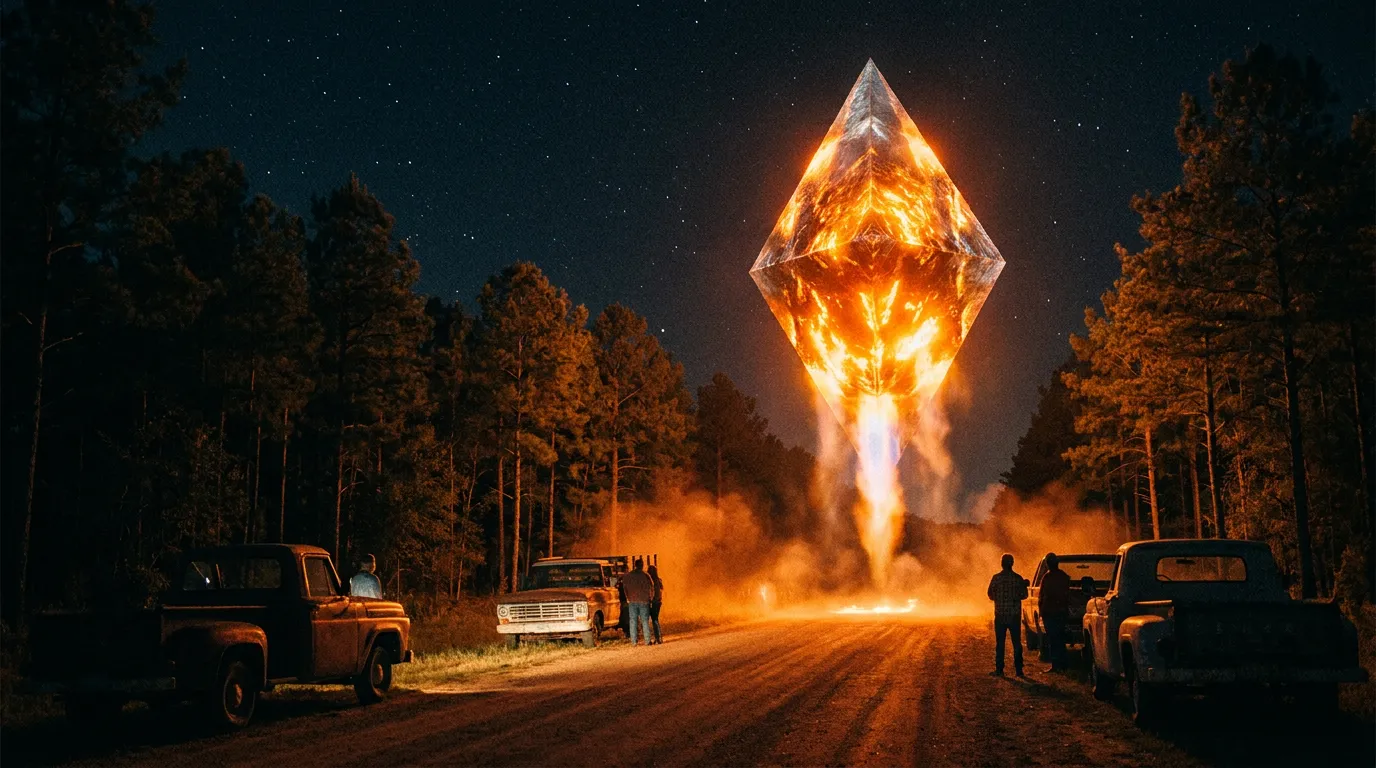
Most UFO cases leave nothing behind but words. Cash–Landrum left injuries. Two women and a child came off a dark East Texas road in December 1980 and, within hours and days, developed a constellation of symptoms — burns, blistering, hair loss, nausea, weakness — that looked disturbingly like the effects of intense heat and radiation. That medical aftermath, documented by doctors, is what separates this case from the thousands of lights-in-the-sky reports. Something injured these people. The question is what.
A wall of fire on the road
On the evening of 29 December 1980, Betty Cash, then 51, Vickie Landrum, 57, and Landrum’s seven-year-old grandson Colby were driving home to Dayton, Texas, after a meal out. Cash was at the wheel of her Oldsmobile Cutlass. Their route ran through the Piney Woods north-east of Houston, near Huffman: two lanes, loblolly pine crowding both verges, no street lighting and almost no traffic on a cold Monday night.
At around nine o’clock they saw a light above the trees ahead. What they described when they reached it was an enormous object hanging over the roadway: a large, diamond- or cone-shaped craft, glowing brilliantly and — most memorably — periodically belching flame downward from its base, roaring, and throwing off ferocious heat.
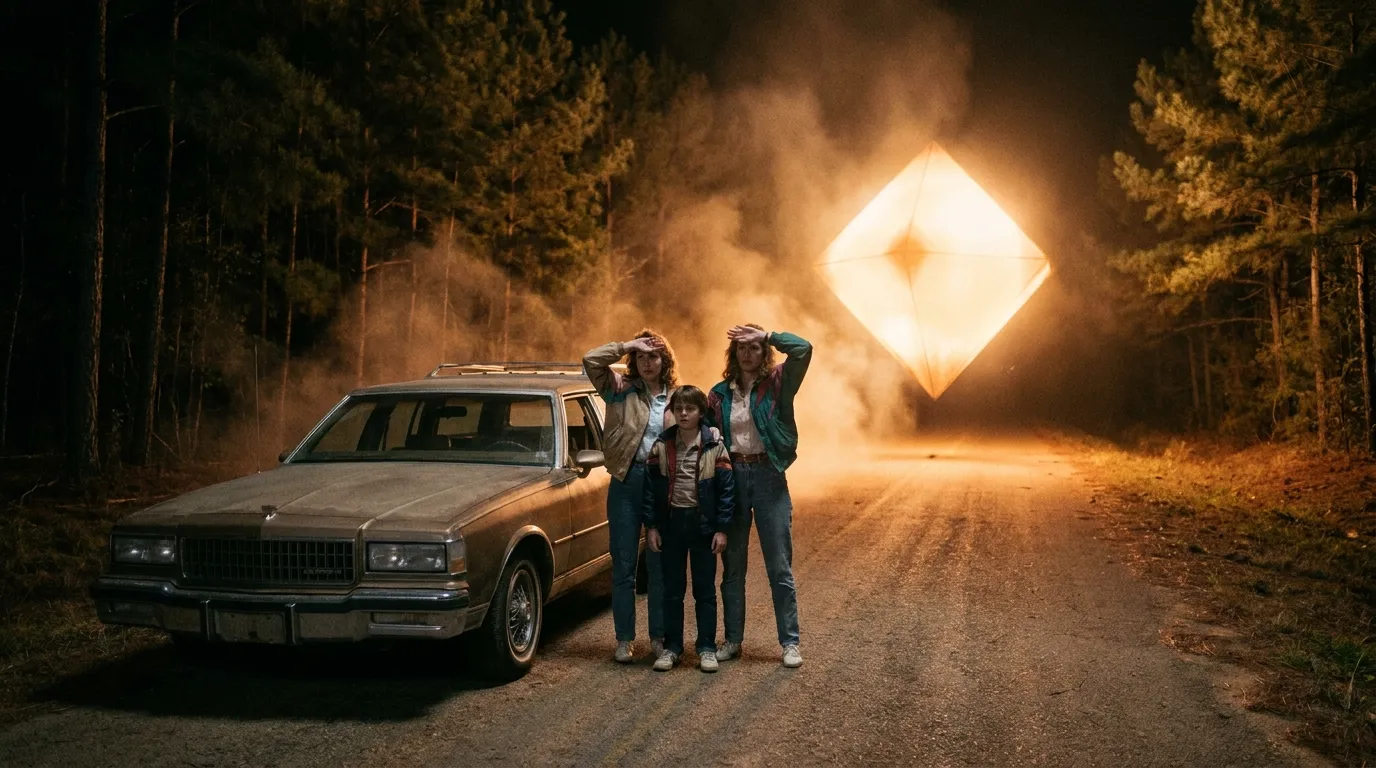
They stopped the car. Cash and Landrum both got out; Colby was frightened enough that Landrum climbed back in to hold him, leaving Cash standing in the road for several minutes longer than either of the others. When she went to get back in, she said, the door handle was too hot to grip bare-handed. Landrum would later claim she had pressed her hand into dashboard vinyl softened by the heat.
By the witnesses’ own reckoning the whole encounter ran to roughly twenty minutes — an extraordinarily long time to stand in front of something you cannot identify, and long enough that the failure to fix the exact spot on the road would later become one of the case’s most damaging weaknesses.
The helicopters
Then came the detail that turns the case from a strange light into something with fingerprints. As the object moved off, the witnesses said, it was surrounded and seemingly escorted by a swarm of helicopters — many of them, and specifically the large tandem-rotor, twin-blade type, which they and later investigators identified as military CH-47 Chinooks. Cash and Landrum put the count at twenty-three.
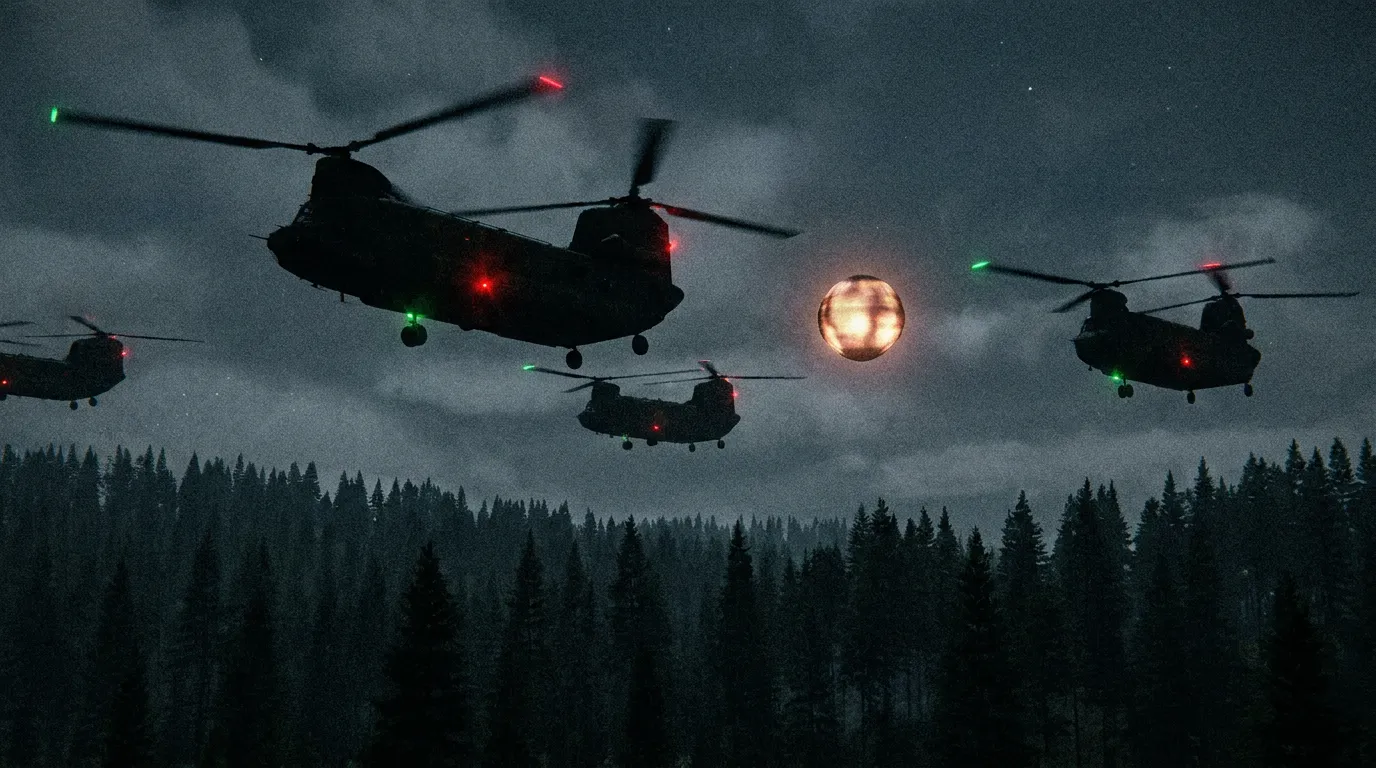
The helicopters matter enormously. A glowing craft alone is a mystery; a glowing craft ringed by two dozen military helicopters implies that someone with a fleet knew about it and was involved. It reframes the case from “unknown object” to “something the military may have been escorting, testing, or chasing” — which is exactly the thread the witnesses would later try, and fail, to pull in court.
It is also the only part of the story that anyone else independently reported. Investigators subsequently traced a Dayton police officer, Detective Lamar Walker, and his wife, who said they had seen around a dozen tandem-rotor helicopters in the same general area at roughly the same time. They saw no craft and no fire. But a dozen Chinooks over rural Liberty County late on a December night is itself a fact that wants explaining.
The illness, and what the doctors documented
In the hours and days that followed, all three fell ill. Betty Cash, who had been outside the car the longest, was worst affected: severe nausea and vomiting, blistering and reddening of the skin, swollen eyes, hair coming away in handfuls, and weakness that put her into Parkway Hospital in Houston, where she was admitted as a burns patient and stayed the better part of a month. Vickie and Colby Landrum suffered milder versions of the same picture.
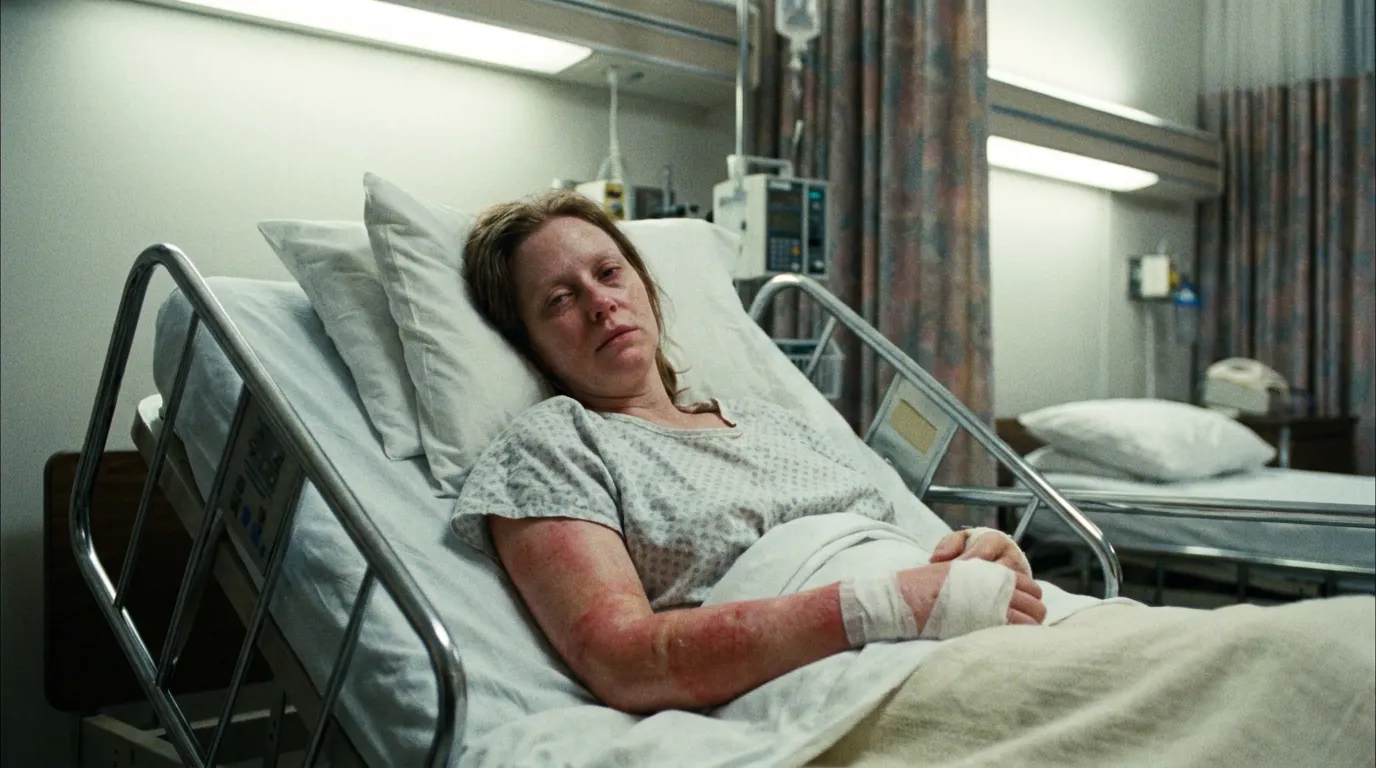
The strongest medical advocate for the radiation reading was Dr Bryan McClelland, the Texas physician who cared for Cash for the rest of her life — reportedly without charge. He told the Houston Post that her illness was a textbook radiation injury, and put the dose at somewhere between one and two grays. Cash later developed breast cancer and died in 1998.
That testimony deserves respect and also scrutiny. McClelland is a family and geriatric practitioner rather than a radiologist, and he did not begin treating Cash until the mid-1980s — years after the acute phase he was characterising. The specialist who did review the file for MUFON, the radiologist Dr Peter Rank, accepted that the women showed symptoms resembling radiation sickness but flagged the gap that matters most: there were no well-documented changes in their blood.
That is not a technicality. Acute radiation syndrome has a fingerprint, and it is haematological — a collapse in white cells and platelets that shows on a full blood count in the days after exposure. Burns, vomiting and hair loss are consistent with a serious dose. A normal blood picture is not.
Schuessler, Sarran and the paper trail
The investigator who made the case is John F. Schuessler: an aerospace engineer who worked on NASA’s crewed spaceflight programmes for McDonnell Douglas at the Johnson Space Center, and a founding member of the Mutual UFO Network. He took the case on early, stayed with it for the best part of two decades, and set it down in his 1998 book The Cash–Landrum UFO Incident. Almost everything the public knows about the case passes through him.
Publicity arrived in 1981. The ABC programme That’s Incredible! filmed a reconstruction that July and, in November, broadcast Vickie Landrum retelling the encounter under hypnotic regression — a technique that reliably produces vivid, confident, unreliable testimony, and which would disqualify the account in any serious evidentiary setting. The broadcast did have one genuinely useful consequence: it prompted the army to look.
In the spring of 1982 the Department of the Army Inspector General sent Lieutenant Colonel George C. Sarran to Texas. He spent months on it, met Schuessler, worked the cold leads and interviewed the available witnesses. His finding is the most-quoted line in the whole file, and it cuts both ways. Sarran judged Cash, Landrum, Detective Walker and Walker’s wife all to be credible, with no sense that anyone was trying to exaggerate. He also found no evidence that the helicopters had belonged to any branch of the US military.
Before that, in August 1981, Cash and Landrum had been directed to the Judge Advocate claims office at Bergstrom Air Force Base outside Austin. They were interviewed at length and, in the end, advised to hire a lawyer.
Twenty million dollars and a locked door
They did. The women pursued a $20 million claim against the United States government for their injuries, and the case ground through the federal courts for years before US District Judge Ross Sterling dismissed it on 21 August 1986. The court accepted the government’s position: no agency of the United States owned or operated a craft of the kind described, and no branch of the service had flown the helicopters the witnesses reported. Assistant US Attorney Frank Conforti made the narrow legal point that decides such cases — you cannot hold the government liable for something it neither owns nor controls.
Read the denial carefully, because its shape matters. “No such craft exists in the military arsenal” is a much narrower statement than “nothing happened on that road.” It survives an accident, a contractor programme, a foreign object, or a recovery operation nobody wanted logged. It is either simply the truth, or the neatest available form of words — and the case gives you no clean way to decide which.
The sceptic’s case, at its strongest
The sharpest objection came not from a professional debunker but from Brad Sparks, a UFO researcher of long standing. Writing in 1999, Sparks argued that the timing does not work: symptoms appearing within hours imply an enormous dose, and a dose that large kills within days or weeks. All three witnesses survived for years. Sparks concluded the illness was not ionising-radiation sickness at all, and suggested chemical contamination — an aerosol of some kind — as the better fit for burns and vomiting without the blood picture.
Curt Collins, who spent years reworking the primary documents, added the mundane objection that may be the most damaging of all: nobody can say where it happened. Neither the witnesses nor Schuessler could pin the location down beyond a stretch of road somewhere between a beer joint and some kind of highway warning sign.

Without a location, there is nothing to test. You cannot look for scorch marks, sample the soil, reconstruct sightlines, canvass the nearest houses, or check whether the treeline could have hidden a hovering object of the size described. A case that rests on physical effects has no physical scene.
Nor is the medical record as public as its reputation suggests. Schuessler was reluctant to release the file beyond his own circle, and by 2009 Cash’s hospital records reportedly could not be retrieved even by her own physician. A case whose entire distinction is documentation is poorly served by documentation that outsiders cannot read. Philip J. Klass, Peter Brookesmith, Steuart Campbell and Brian Dunning have all pressed on one or another of these seams.
Why the case still gets cited
Cash–Landrum survives because it belongs to the small category of reports that claim to have left marks on the world rather than only on memory — the same category as the burned and stunted plot at Trans-en-Provence or the stalled engines at Levelland. Those cases are rare, and they are the only kind that could, in principle, ever be settled.
They are also the cases that expose how badly the field has handled evidence. The Cash–Landrum file went through a talk show, a hypnosis session, a single custodial investigator and a lost hospital archive before it ever reached anyone equipped to audit it. That sequence, not the object over the road, is the reason it will never be resolved — and it is precisely what a modern process is meant to prevent.
The UAP Times take
Cash–Landrum earns an Unconfirmed rating, three out of five on our scale, and it is one of the most substantial cases on the map precisely because of the injuries. This is not merely a story: real people became genuinely, seriously ill after the event, an army investigator who went looking for holes found the witnesses credible, and a second, independent pair of witnesses reported the helicopters.
But the case has been steadily eroded by the things that ought to have made it strong. The radiation diagnosis rests on a physician who arrived years late, and the blood work that would have confirmed it isn’t there. The site was never fixed. The records were never opened. The most reliable single finding in the whole file is Sarran’s, and Sarran found no military helicopters.
Something real, hot and dangerous was on that road. Almost everything after that is contested.
Our reading is that the most tantalising possibility Cash–Landrum raises is not extraterrestrial at all: that three civilians stumbled onto an operation, an accident, or a piece of hardware that no agency was ever going to acknowledge in open court. It remains perhaps the strongest UFO case ever to produce documented human injury, and the flat institutional denial in the face of three hurt civilians is the part that has never sat right. But an unresolved case is not a proven one, and forty-five years of lost paperwork have put the answer permanently out of reach.
Further reading: for another case where a craft’s presence coincided with equipment and human effects, see Levelland 1957 and Rendlesham Forest. For the physical-trace case that was actually analysed in a state laboratory, see Trans-en-Provence. For the other great injury case — burns, radiation questions and a file nobody closed — see Falcon Lake 1967. The Cash–Landrum object was a classic diamond; it’s on the sightings map.
Source: Witness testimony; medical records; investigations by John Schuessler/MUFON; a US federal lawsuit
Follow the file
Every new dispatch from the UAP desk, in your inbox. Sourced, sceptical, and no more than one email a week.