
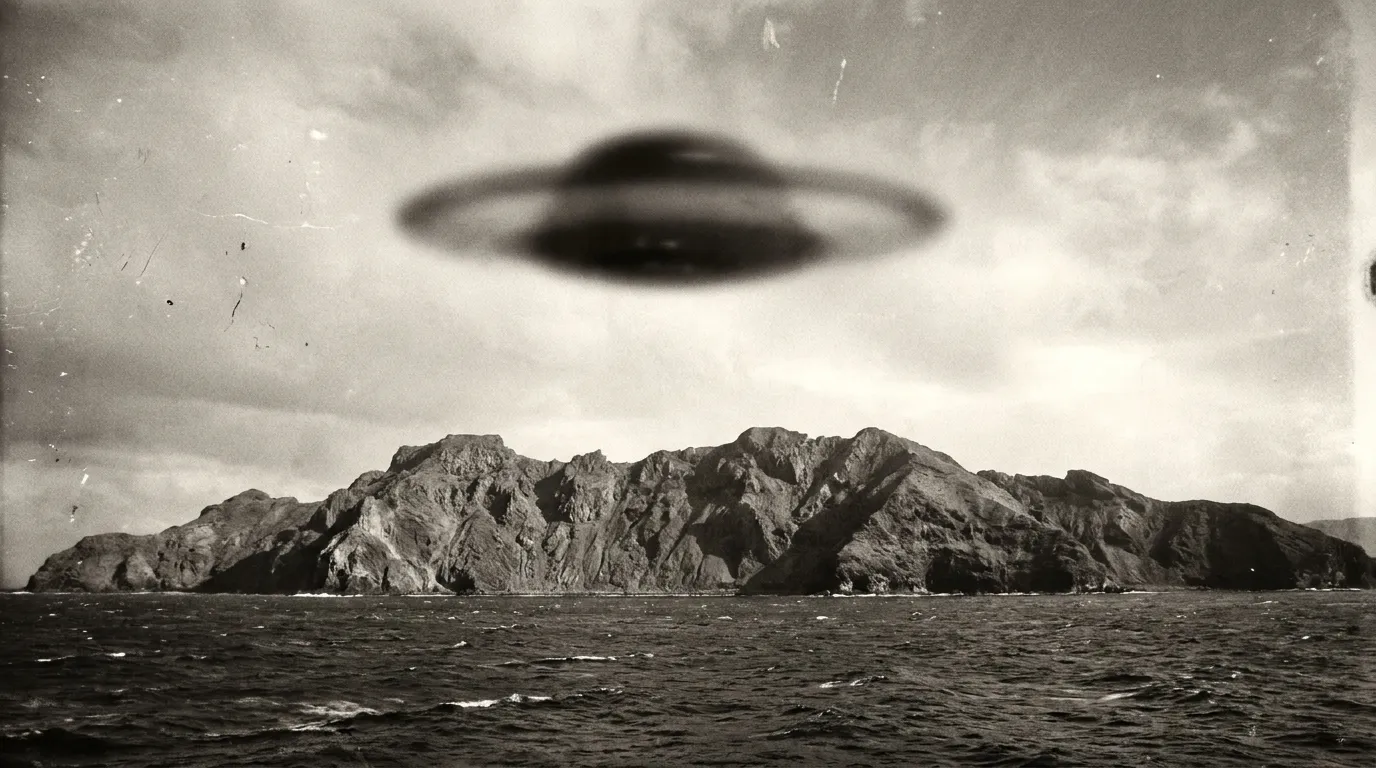
For a certain generation of UFO researcher, the Trindade photographs were the gold standard: clear images of a genuinely strange object, taken in front of witnesses, from a naval vessel, and vouched for by a national government. That pedigree is real, and it is why the case mattered so much. It is also why the doubts about it cut so deep — because the entire edifice rests on the honesty of one man with a camera, and that man had a complicated history.
An island at the edge of nowhere
Trindade is a rugged volcanic speck in the South Atlantic, roughly a thousand kilometres off the Brazilian coast, jagged and remote. In January 1958 the Brazilian Navy vessel Almirante Saldanha was there in support of the International Geophysical Year — the eighteen-month global science programme that put ships and stations in exactly this kind of unpromising place. Among those aboard was Almiro Baraúna, a civilian photographer along to document underwater work.
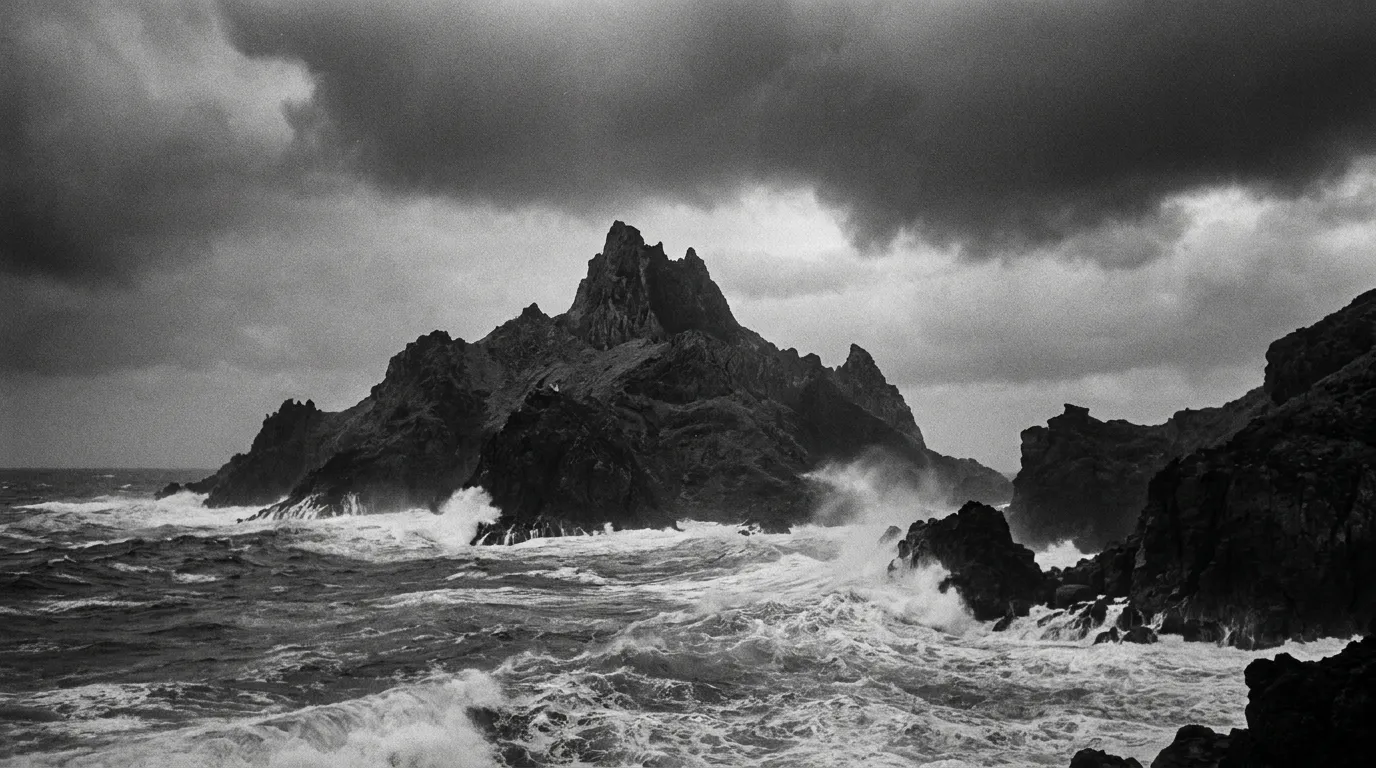
Trindade already had form. Personnel at the island’s small oceanographic post had logged sightings of unidentified objects over the preceding weeks, from early December 1957 into the new year. Whatever else it is, the 16 January event did not arrive out of nowhere; it landed in a place where people had already been writing things down.
Twelve-twenty on the deck
The ship was preparing to leave. That timing matters, because it explains why so many people were up top rather than below: departure from an anchorage puts crew and passengers on deck.
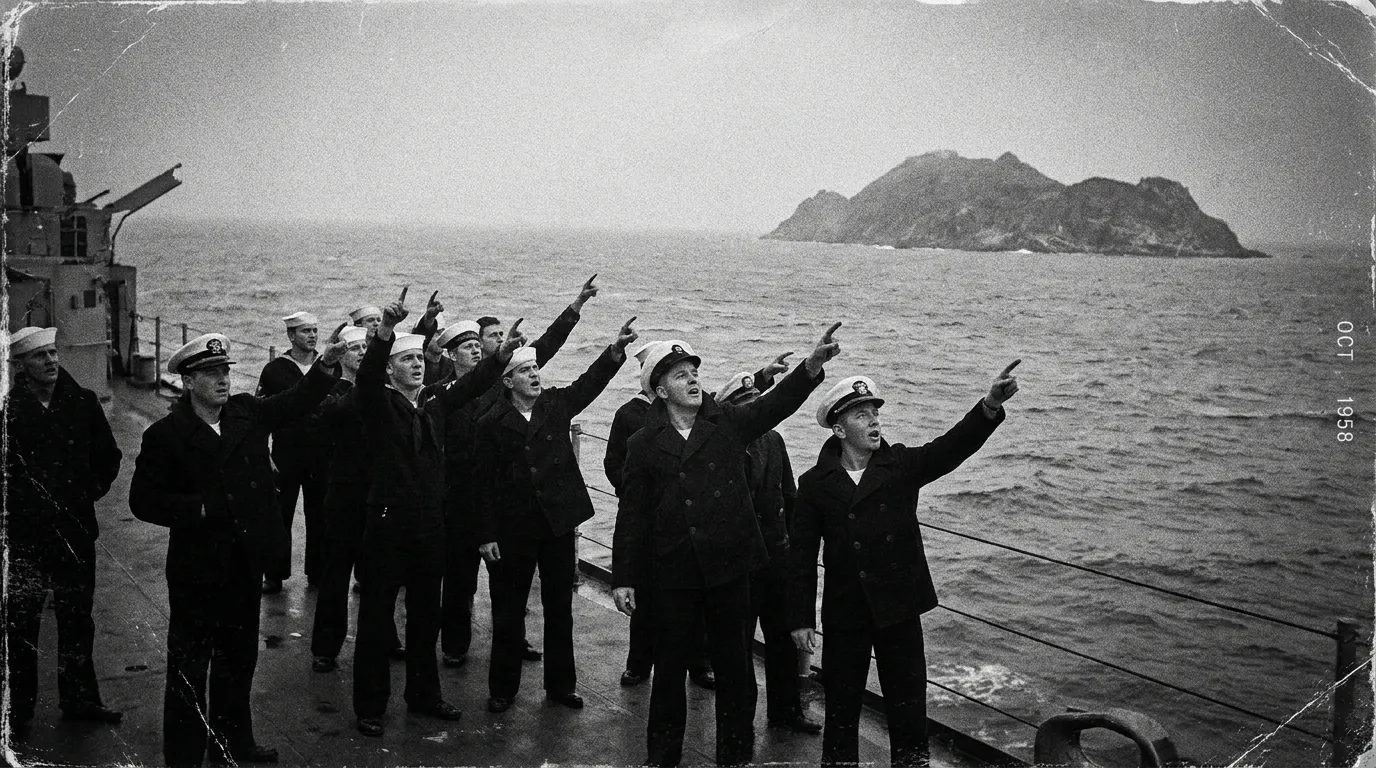
At around 12:20 local time, according to the accounts, an object appeared over the island and a commotion broke out. Numbers vary in the retellings — figures of forty-seven or forty-eight people aboard are commonly quoted — but the number who gave first-hand accounts of actually seeing the object is considerably smaller, and worth separating from the ship’s complement.
Two names recur. Amilar Vieira Filho, president of the Icaraí underwater fishing club, and José Teobaldo Viegas, a Brazilian Air Force Reserve captain, were with Baraúna and reported seeing it. One name that does not belong on the deck is the one most often invoked: Carlos Alberto Ferreira Bacellar, the corvette captain commanding the island’s oceanographic station, was not present for the 16 January sighting. He had witnessed a different phenomenon ten days earlier, and he later compiled the official paperwork — which is a different thing from being an eyewitness, and gets conflated constantly.
The object was in view for something on the order of a minute. In that window Baraúna raised his camera and fired off a sequence of frames.
A ring around a disc
He exposed six, at intervals of roughly fourteen seconds. Four caught the object; two — frames four and five — show only sea and the island’s rocky coastline, the by-product of a man swinging a camera around a crowded deck while people shout.
What the developed negatives showed became one of the most reproduced UFO images of the era: a Saturn-shaped object — a central body girdled by a broad ring — over the island’s peak, then apparently moving off out to sea. The photographs did not appear in a vacuum, but alongside human witnesses on a naval vessel, which is the case’s real strength. And then the story acquired its trump card.
The darkroom on the ship
The single most important claim in the case’s defence is procedural rather than photographic: that the film never left responsible hands between exposure and development.
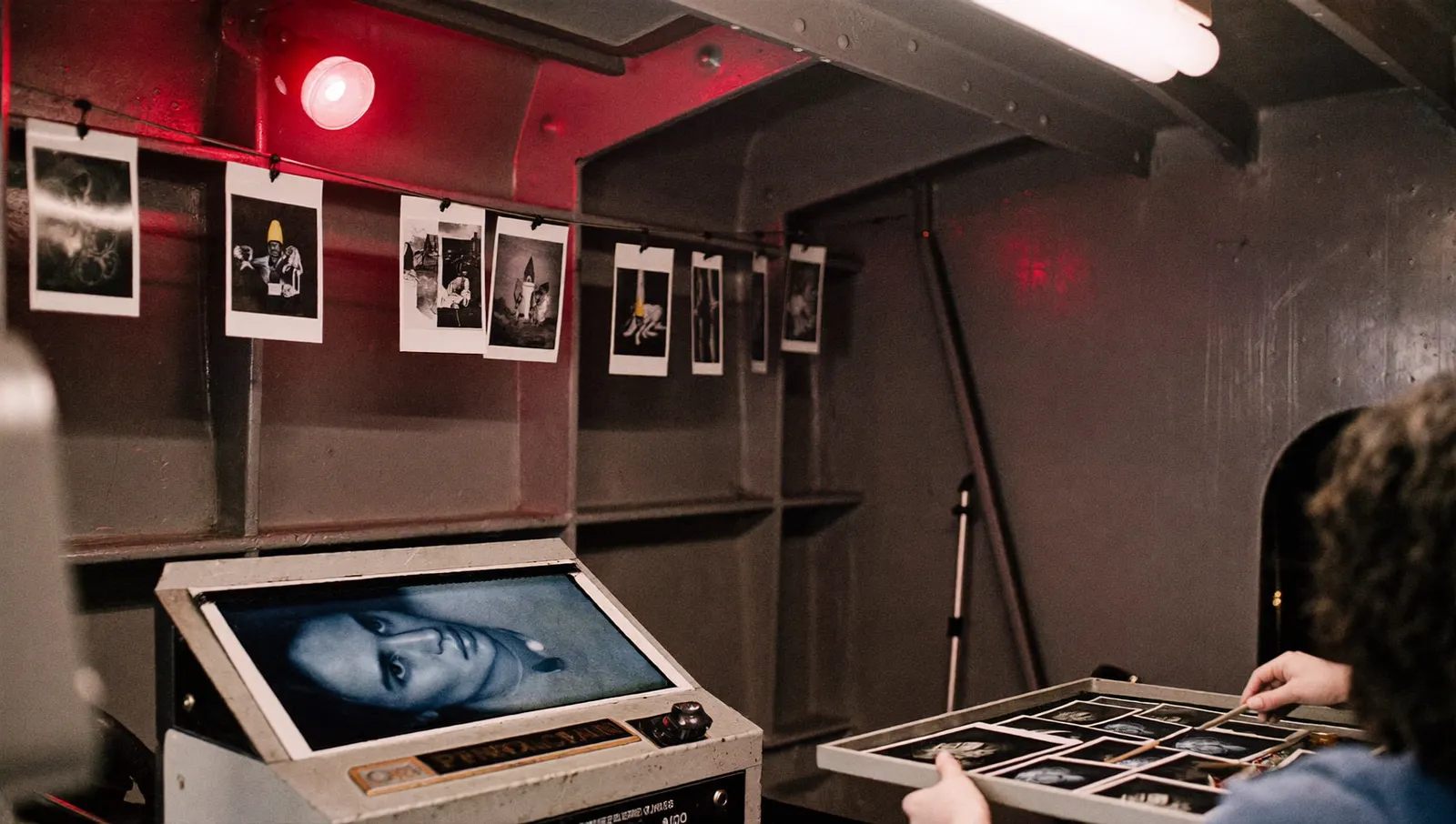
By the accounts, the roll was developed promptly aboard the Almirante Saldanha, with Baraúna observed while he worked, specifically so that nothing could be substituted or added. If that is accurate, it closes off the crudest hoax routes — a swapped roll, a print produced later at leisure.
It closes off rather less than defenders sometimes suggest. Supervision at the development stage says nothing about what was on the film before it went into the tank, and the double-exposure hypothesis that sceptics would later advance is specifically an in-camera trick. A man being watched in a darkroom is being watched at the wrong end of the process.
The government that stood behind it
The images went up the chain, and the chain did something almost unheard of: it backed them.
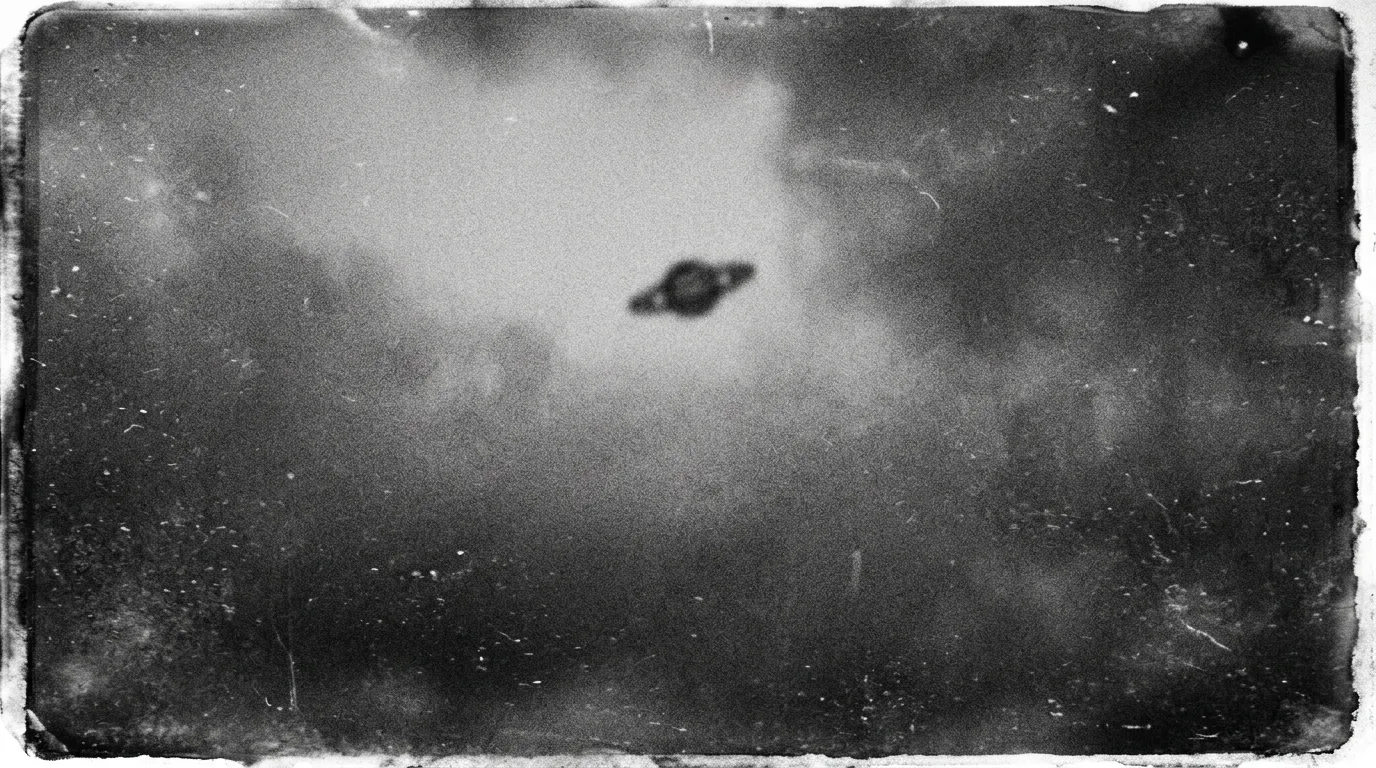
The pictures were examined by the Brazilian Navy’s aerial reconnaissance laboratory and by the Cruzeiro do Sul aerial-survey service, both of which reported them genuine. President Juscelino Kubitschek handed copies to a reporter from the Rio daily Correio da Manhã, which put them on its front page on 21 February 1958. Four days later, the Navy Ministry publicly vouched for the photographs. On 27 February, the Chamber of Deputies filed a formal request for information demanding that the Ministry answer for the whole business.
Official governmental backing for UFO photographs was, and remains, vanishingly rare. It is what lifted Trindade above the endless parade of blurry snapshots — and it is the plank of the case that has aged least well.
What the endorsement was actually worth
Strip the sentence “the Brazilian Navy authenticated the photographs” down and you find something narrower than it sounds.
What the laboratories were asked was whether the negatives showed signs of tampering: retouching, montage, physical alteration of the film. Their answer was no. That is a real finding, and by the standards of 1958 photographic forensics it was competently arrived at. But “this negative has not been physically doctored” and “this negative records a genuine unknown object” are separated by every trick that happens inside the camera rather than after it.
There is a further wrinkle the case’s supporters rarely raise. Bacellar’s report is titled as a clarification of observations at Trindade across a period running from December 1957 to 16 January 1958 — it is a summary of a run of sightings at the station, not a forensic verdict on four frames of film. Institutional Brazil took the episode seriously. It did not, in any strict sense, certify a flying saucer.
The photographer’s shadow
Here is the problem that has followed Trindade for decades. Almiro Baraúna was not a random sailor who happened to have a camera. He was a skilled photographer with a known interest in trick photography — and in 1954 he had produced a deliberately faked flying-saucer photo-story for the Brazilian magazine Mundo Ilustrado, explicitly to demonstrate how easily it could be done.
A man who has publicly shown he can fake a flying-saucer photograph is precisely the man whose genuine flying-saucer photograph you must scrutinise hardest. The Americans reached that conclusion immediately. The US naval attaché’s report on the case, which fed into Project Blue Book, described Baraúna as a man with a long history of photographic trick shots and floated the blunt theory that the whole thing was a publicity stunt by a crooked photographer that the Brazilian Navy had swallowed. Blue Book’s analysis, via the Air Technical Intelligence Center, came down on “probably a hoax” — though one Blue Book record card concedes the awkward detail that ATIC had been unable to obtain copies of the photographs it was assessing.
The most specific sceptical mechanism came from the Harvard astronomer Donald Menzel, the era’s most energetic debunker. Menzel first suggested an aircraft seen through fog, then shifted to arguing that Baraúna had photographed a model at home and double-exposed the same roll with shots of open sky. Menzel’s habit of producing successive incompatible explanations for the same case is itself a caution about his method — but the double exposure is at least a testable proposal, which is more than most.
Defenders answer that a 1978 examination of the images using digital analysis reported no evidence of the double exposure Menzel described, and that nobody in nearly seventy years has actually reproduced the sequence as a demonstrated hoax. Both points are fair. Neither is proof.
The confession that arrived fifty-two years late
In August 2010 the case took its heaviest blow, from Brazilian television rather than from any laboratory. Globo’s prime-time programme Fantástico aired claims that Baraúna had privately admitted faking the images — the story, relayed by a friend, involving two spoons joined together and photographed against a refrigerator. Around the same period, a nephew of Baraúna told the Brazilian magazine Revista UFO that the pictures were a trick.
The claim is damaging and it is also, examined closely, in poor shape. Baraúna died in 2000, so nothing about it can be put to him. It is second-hand at best. And the vivid detail that makes it memorable is the detail that does not work: Baraúna was not at home when the photographs were taken, he was on a naval vessel a thousand kilometres offshore, where the only refrigerator available belonged to the ship’s galley. There is a plausible, boring reading in which an elderly man reminiscing about the fakes he did make — the 1954 magazine job — was misremembered decades later as confessing to the ones he denied.
Weigh against that a document that surfaced in the same period: a typewritten statement dated 30 January 1967, signed by Baraúna, defending the photographs. Nine years after the event, and thirty-three before his death, he was still saying the same thing.
The 2010s brought the Brazilian archives themselves into play. Following a request for information from Deputy Chico Alencar, the Ministry of Defence set out how Brazil’s UFO records from the 1950s onwards were to be declassified and transferred to the Arquivo Nacional. The files went public. What they contain is a state taking reports seriously — investigations, correspondence, chains of command — rather than any answer to the question everyone actually wants answered.
The UAP Times take
Trindade earns an Unconfirmed rating, three out of five on our scale, and it is a near-perfect illustration of why provenance matters as much as pixels. On paper it has everything: a clear object, multiple witnesses, a naval setting, government endorsement. In practice, every one of those planks is thinner than the summary version. The witnesses were fewer than the ship’s complement implies and the most-cited officer was not among them. The endorsement was a finding about film, not about physics. And the single most important fact remains who was holding the camera — a talented photographer with a documented history of manufacturing exactly this kind of image, for publication, on purpose.
That history does not prove the Trindade photographs are fake. Supervised development, on-deck witnesses, a prior run of sightings at the island, and a claimed statement he never retracted are not nothing. The 2010 “confession” is second-hand, unfalsifiable and factually clumsy, and anyone treating it as a closing argument is doing the same thing they accuse the believers of.
But the case can never climb higher than unconfirmed, because its central evidence is exactly the kind this particular witness had already shown he could produce to order. Trindade teaches the hardest lesson in this whole field: a striking photograph is only ever as trustworthy as the hand that held the shutter — and no amount of official letterhead stacked on top of it changes that.
Further reading: for another famous photograph that collapsed on closer inspection, see the Petit-Rechain image in The Belgian Wave. For the other Brazilian case that turns on how much weight official Brazilian sources can carry, see Varginha 1996. For the other occasion a Brazilian armed service put its own name to strange imagery, see Colares 1977. Trindade’s object is the classic Saturn / ringed disc; it’s on the sightings map.
Source: Brazilian Navy statements; contemporary Brazilian press; analyses of the Baraúna photographs
Follow the file
Every new dispatch from the UAP desk, in your inbox. Sourced, sceptical, and no more than one email a week.