Shag Harbour is the case the official record cannot shake off, because the official record made it. This was not a story that circulated in a magazine and got dressed up over the decades; it began as a police report, filed the same night, when villagers and Royal Canadian Mounted Police officers watched something descend into the cold Atlantic and triggered a genuine air-sea rescue response for a crash with no aircraft missing. Canada’s own government files carry it, to this day, as an unsolved case. That pedigree is rare, and it is why Shag Harbour sits near the top of our list.
Lights over the water
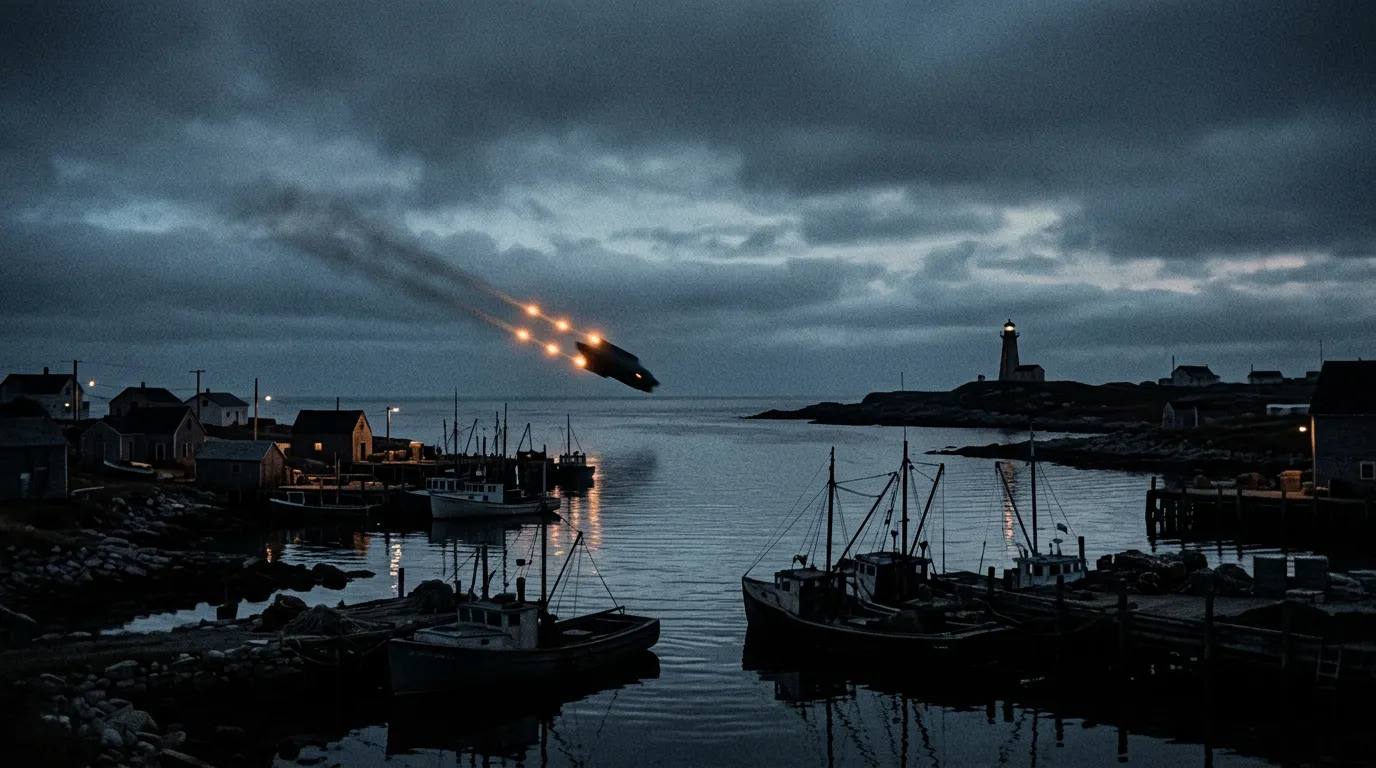
On the evening of 4 October 1967, in the tiny fishing community of Shag Harbour on the southern tip of Nova Scotia, multiple people independently saw a low string of bright lights in the sky. At around 11:20pm Atlantic Daylight Time, a group of teenagers driving on Highway 3 — among them seventeen-year-old Laurie Wickens — watched the lights descend towards the harbour at a shallow angle of roughly forty-five degrees and strike the surface of the water. Several witnesses described a bright flash and a whistling or rushing sound, and then a pale object floating on the sea before it sank.
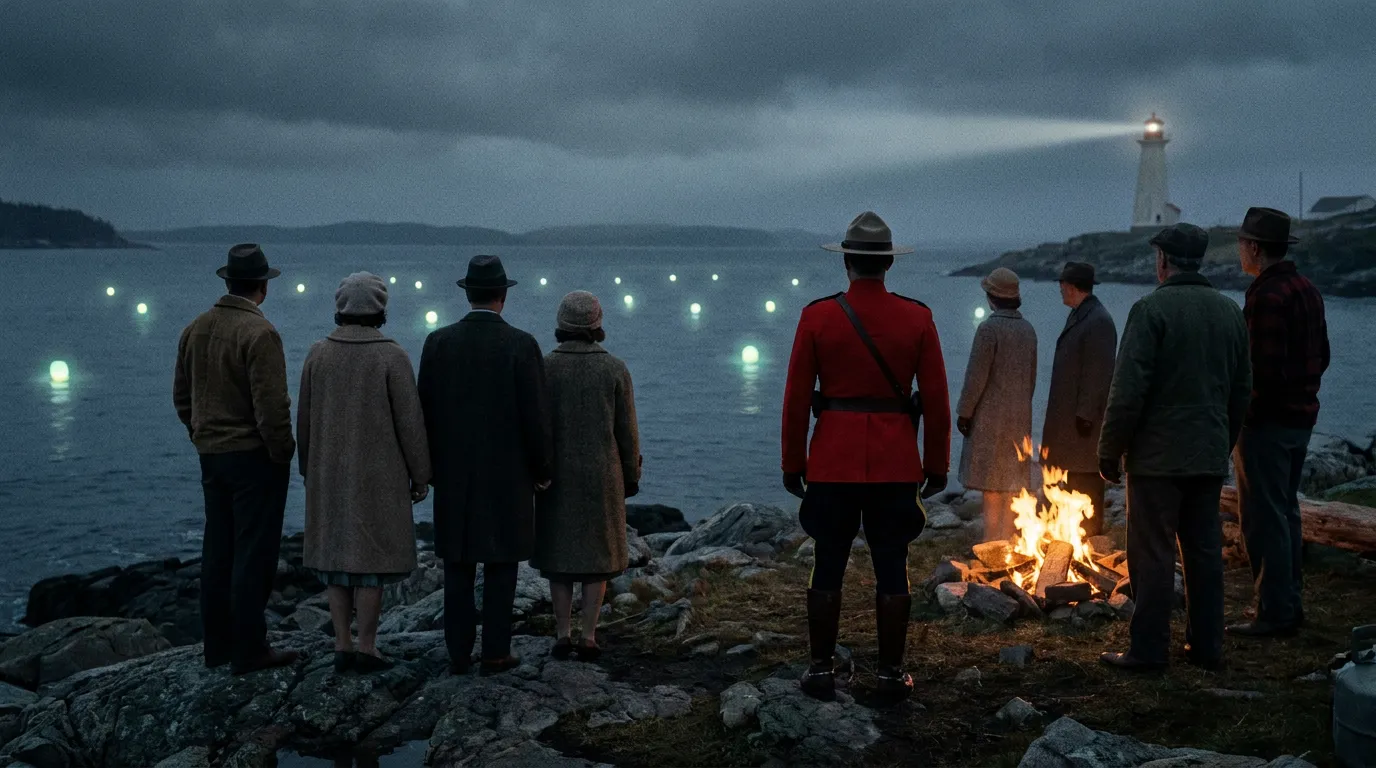
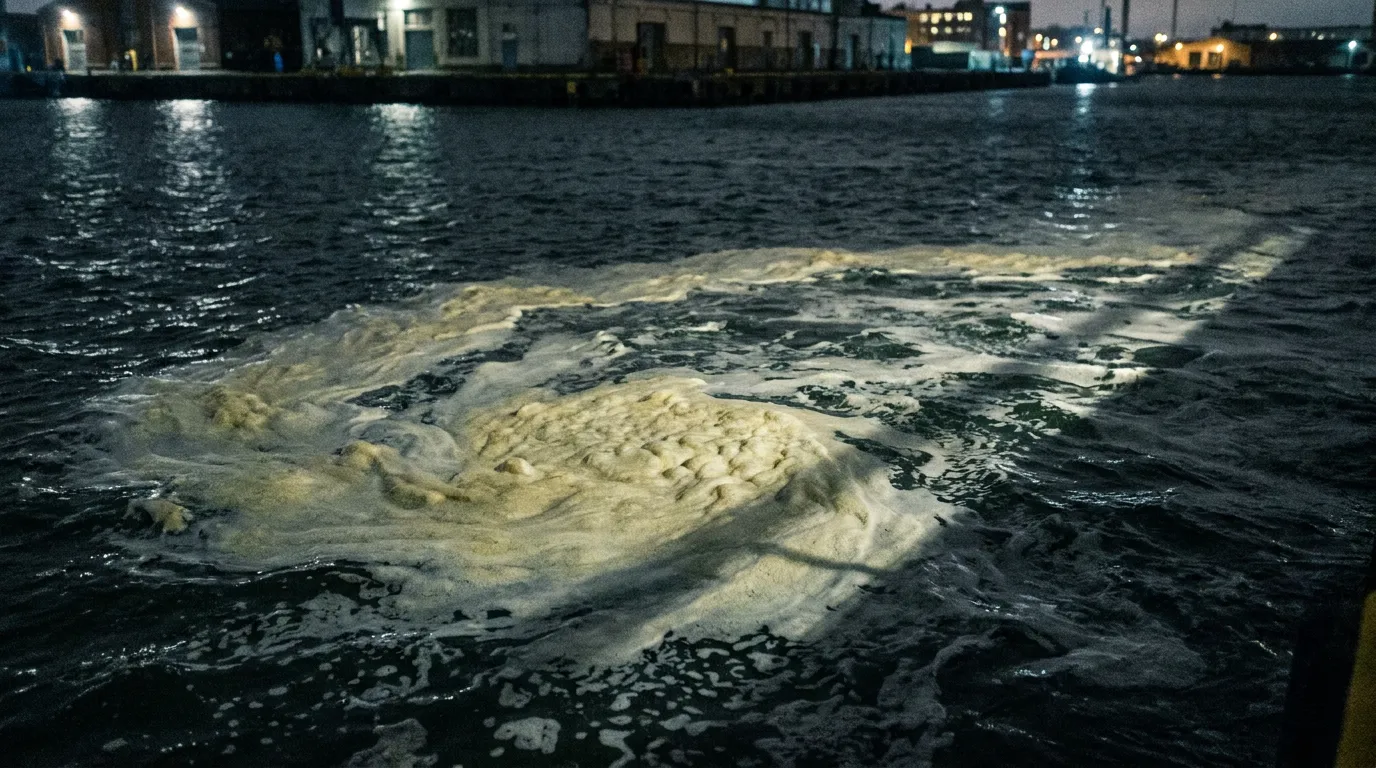
Wickens drove on to the RCMP detachment at Barrington Passage and reported what he had taken to be an aircraft going into the sea. Constable Ron Pound, heading for the harbour along Highway 3, saw a light himself, and on reaching the shore watched a yellow glow moving slowly on the water, trailing a band of yellowish foam behind it. He was not a UFO witness in his own mind that night. He was a police officer looking at what he believed to be a downed aeroplane.
A rescue with nothing to rescue
Local fishing boats put out into the dark harbour to look for survivors or wreckage. They found a patch of yellowish foam on the surface — and nothing else. No bodies, no oil slick of the expected kind, no debris field, no sign of an aircraft.
The response escalated through the proper channels. The RCMP contacted the Rescue Coordination Centre in Halifax; a check of civil and military traffic confirmed that no aircraft was missing or overdue. With no crash to attribute the sighting to, the RCMP, the Rescue Coordination Centre and the Royal Canadian Air Force were left with an object that met the administrative definition of a UFO precisely — something in the air that nobody could identify.
The paper trail
What lifts Shag Harbour above the ordinary is the documentation. The incident generated contemporaneous RCMP reports and military message traffic, filed while the event was fresh and by people with no incentive to invent a flying saucer — they were logging what they genuinely took to be a possible fatal crash.
One government message memorably recorded that the object was not a known aircraft and the sighting could not be explained. In the files it stands as one of the very few cases where a national government’s own paperwork uses, in effect, the words “unidentified flying object” as a plain administrative fact rather than a rhetorical flourish. The relevant Department of National Defence and RCMP material is held at Library and Archives Canada, which is a duller sentence than “the government covered it up” and a considerably more useful one.
What the search actually did
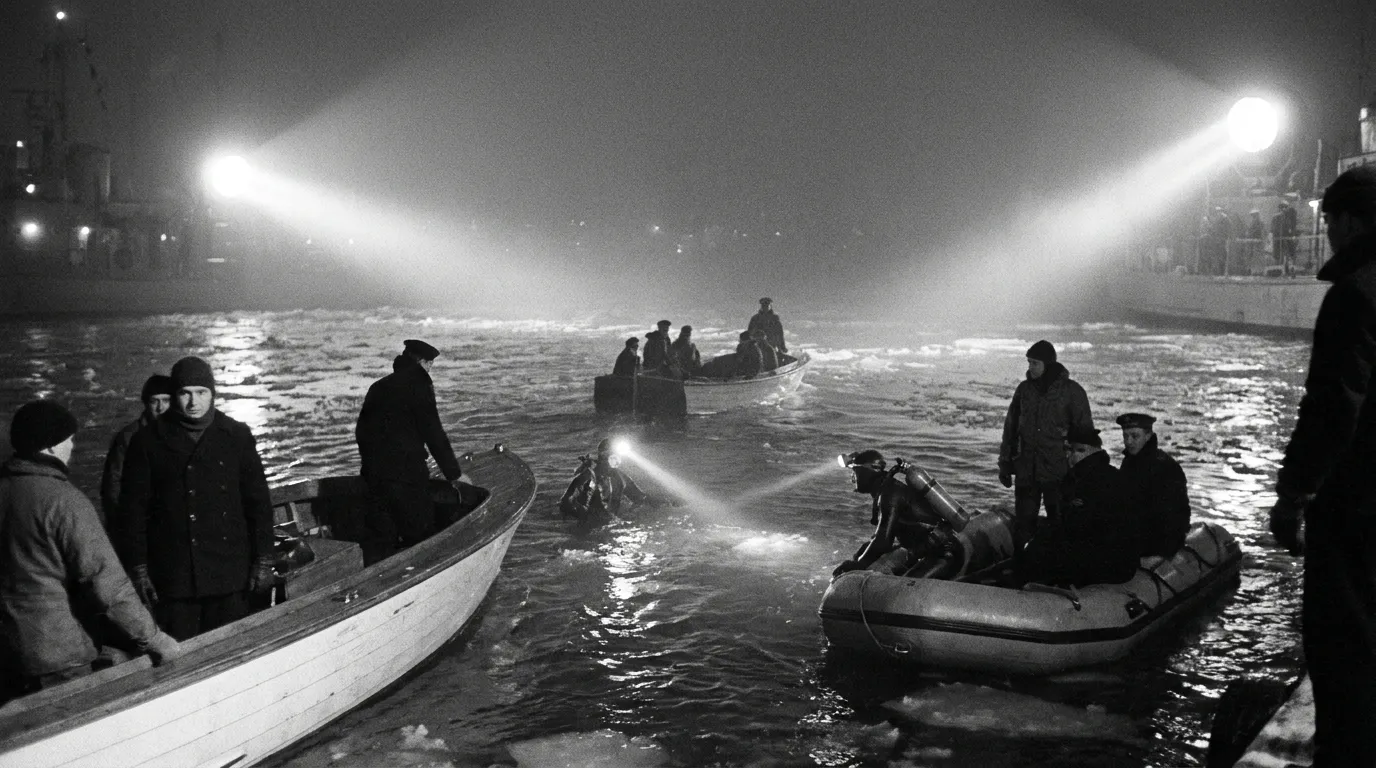
The naval phase is the part most often overstated and least often described. Over the days following 4 October, Canadian Forces Maritime Command ran an underwater search of the harbour and the approaches, with divers working the seabed in shallow, cold, silty water. The frigate HMCS Granby is the vessel most consistently named in accounts of the diving operation.
They found nothing. No hull plating, no engine, no fuel, no personal effects, no impact scar on the bottom that anyone recorded. On 9 October the Halifax Chronicle-Herald reported, under the headline “UFO Search Called Off”, that Maritime Command had ended an intensive undersea search for the object that had gone into the ocean the previous Wednesday night.
That is a genuinely double-edged result, and it deserves to be read both ways. A negative search is not evidence of an exotic craft; it is evidence that nothing recoverable was there. Equally, it is evidence against several of the ordinary explanations — an aircraft, a jettisoned fuel tank, a boat — because those leave wreckage, and a professional dive team looking in the right place did not find any.
The limits matter too. This was 1967, in a working fishing harbour, with 1967 equipment. Bottom sediment, tide and a few days’ delay will defeat a diver where they would not defeat a modern side-scan sonar survey. The absence of a find is a weaker fact than it sounds.
The witnesses, and what testimony can carry
Shag Harbour’s witness pool is unusually good for a 1960s case, and it is worth being specific about why. The observers were multiple and independent, spread along a stretch of coast rather than clustered in one group. They included teenagers, adult residents and at least one serving police officer. Crucially, their initial interpretation was mundane: they thought a plane had gone down, and they behaved accordingly — driving to a police station, launching boats, searching for survivors in the dark.

That is the strongest thing about the case: nobody was looking for a flying saucer, and the story is not shaped like one. There is no acorn, no hieroglyphic band, no beings. There are lights, an impact, foam, and a fruitless search.
The weakness is equally clear. Almost everything beyond the police reports and the message traffic was collected long afterwards. The Nova Scotian researcher Chris Styles — who was twelve in 1967 and says he saw lights that night himself — began tracking down witnesses in the early 1990s, more than two decades on, and was later joined by the aviation writer Don Ledger; their 2001 book Dark Object is the fullest account in print and also the source of most of the case’s more dramatic later claims. Some of those claims, including accounts of a larger military operation elsewhere along the coast, rest on interviews rather than on released documents, and we would not put weight on them here. Chris Rutkowski, who has catalogued Canadian UFO reporting for decades, gives the case sustained treatment in Canada’s UFO Secrets. Twenty-five-year-old recollections are not worthless, but they are a different tier of evidence from a report written the same night, and the two should never be quoted in the same breath.
The sceptical case at its strongest
The prosaic candidates are real and should not be brushed aside. A bright meteor breaking up on a shallow trajectory can present as a line of lights descending at an angle, and a low-altitude fragmentation can produce a startling flash. Flares — from a vessel, or set off by someone ashore — would account for lights descending to the water and a brief glow floating on it. Aircraft-related explanations, including a jettisoned object or a military exercise nobody chose to log, are not exotic in the Cold War North Atlantic.
The best version of the sceptical argument does not need any of those to be certain. It needs only two observations. First, that a genuinely puzzling five minutes on a dark coast, followed by an official search, is an event that memory will sharpen rather than blur, and most of what we now know about Shag Harbour was gathered after that sharpening. Second, that “the government’s own file says UFO” is doing less work than it appears to: the term is a category for the unidentified, not a finding about the exotic. A file marked unexplained is a statement about the file.
Against that, two facts hold up. A meteor does not float on the water for a period before sinking, which is what several witnesses independently described. And a flare hoax does not survive a Maritime Command dive operation without someone, in sixty years, admitting to it.
What the case changed
Shag Harbour’s afterlife has been quieter and healthier than most. There is no crash-retrieval industry around it, no competing witnesses selling contradictory memoirs, no recovered debris circulating among collectors. The village has a small interpretive centre; the archives hold the file; the case gets cited in the Canadian record as the country’s best-documented unexplained aerial event and not much more is claimed for it than that.
Its lasting value is procedural. Shag Harbour is the clearest historical demonstration that the useful evidence in these cases is generated in the first twenty-four hours, by people doing their jobs — the duty officer who logs the call, the controller who checks for missing aircraft, the dive supervisor who writes up a nil return. Everything of substance in the case came from that machinery. Nothing of substance came from the decades of interviews afterwards.
That is precisely the argument now being made about modern reporting, where the fight is over whether aircrew and controllers have a positive duty to file at all — the subject of the ODNI’s reporting-duty memo. Nova Scotia in 1967 had, by accident, a better pipeline than most military services managed for the next fifty years.
The UAP Times take
Shag Harbour earns a Credible rating, four out of five on our scale, and it is one of the cleanest cases on the map for a simple reason: the witnesses include police, the response was official and immediate, and the documentation was created in real time by a government treating the event as a life-and-death emergency, not a curiosity. The physical residue is thin — foam, and an absence of wreckage — but the human and institutional record is unusually solid.
Our reading is that something real came down into the water off Shag Harbour that night, was seen by sober and independent witnesses including a Mountie, and was searched for by professionals who found nothing to match it. Whether it was an exotic craft, an unlogged aircraft, or a natural object behaving unusually is not resolved and may never be — and we would gently suggest that a modern sonar survey of the harbour floor is the only thing likely to move the case in either direction.
What it is not is proof of anything beyond the ordinary. Strip out the later interviews and you are left with a first-rate unexplained sighting and a nil search result. But as a demonstration that a UFO report can be a matter of official record — filed, searched, and left open by a government rather than a believer — Shag Harbour is close to unmatched.
Further reading: for another case built on multiple credible witnesses and an official response, see The Tehran Dogfight. For how thin the maritime file still is nearly sixty years on, see the single sea-domain case in the Pentagon’s latest annual report. Canada’s other 1967 case, and the one with the thicker paper trail, is Falcon Lake. The Shag Harbour object read as a string of lights on a single craft; it’s on the sightings map.
Source: RCMP incident reports; Canadian government files; contemporary witness testimony
Follow the file
Every new dispatch from the UAP desk, in your inbox. Sourced, sceptical, and no more than one email a week.