
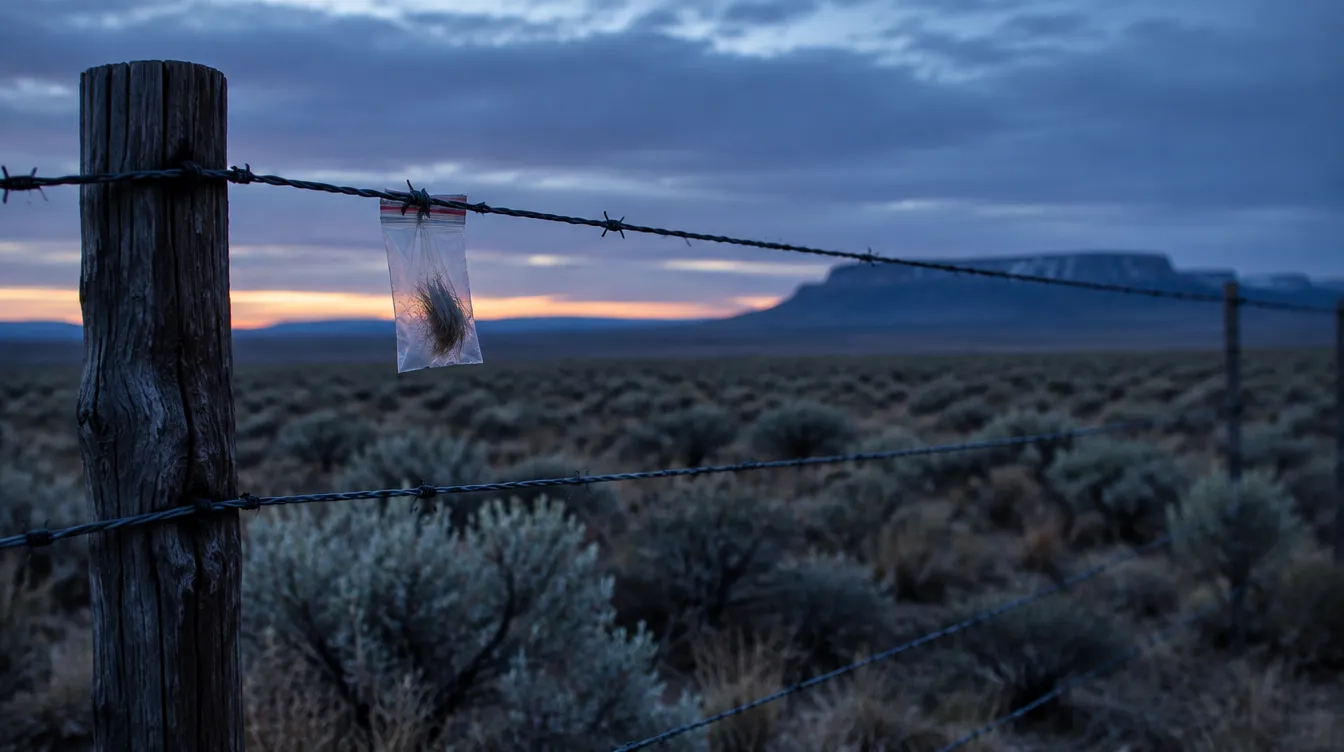
Most of the attention paid to the Pentagon’s seventh batch of UFO files went to a silent black triangle over a western site in June, which is fair enough. Rather less went to a sixty-page document buried in the same tranche, in which four people on a defence intelligence contract drive into the Uinta Basin, interview a rural community about a tall dog-like figure, pull hairs off a fence, and send them to a laboratory.
The laboratory’s answer is the most interesting thing in the Pentagon’s October release, and almost nobody has led with it. The hairs were from a dog.
What was actually published
On Friday 23 October the Department of War released its seventh tranche of declassified UAP records under PURSUE — the Presidential Unsealing and Reporting System for UAP Encounters — adding 28 documents and no video, and taking the published archive to 478 files across seven releases.
Among them, for the first time, is a block of the actual working paperwork of AAWSAP: the Advanced Aerospace Weapon System Applications Program, the Defense Intelligence Agency effort funded by roughly $22 million that Senator Harry Reid secured with two Senate colleagues, and contracted out to Bigelow Aerospace Advanced Space Studies — BAASS — the subsidiary set up by the Las Vegas property billionaire Robert Bigelow. Sources differ on when the money ran dry; contract performance began in September 2008, and the programme is variously described as having ended in 2010 or limped to 2012.
This is the programme that has been argued about for nine years — whether it was a serious threat-assessment effort mislabelled in the press as AATIP, or a paranormal research project with a defence budget line. The files now let you read its own filing cabinet rather than the arguments about it.
The documents include DOW-UAP-D167, a December 2008 plan called Project Capella, proposing a data warehouse to capture, classify and retrieve records of unusual aerial phenomena; D168, the BAASS project management plan of 2 December 2008; D173, the November 2009 monthly progress report, which refers to a separate Utah Ranch database; and D175, a 141-page November 2010 summary of BAASS’s analysis capabilities — staff, software, field sensors, data warehousing, and multiphysics modelling tools for reconstructing incidents.
And then there is D174.
Two deployments, four hair samples
D174 is titled “Utah Ranch Investigation”, dated April 2010, and runs to roughly sixty pages. It documents two field deployments — 22 to 26 March and 19 to 23 April 2010 — by a four-person BAASS team described as two investigators and two scientists, working in the area around Fort Duchesne in north-eastern Utah.
The ranch itself is redacted throughout. Every outlet that has covered the file has identified it as the property later sold and televised as Skinwalker Ranch, and the geography makes that the obvious reading, but the document does not name it.
What the team did was conventional field work. They took statements from local residents describing a tall bipedal dog-like figure, odd lights, and in at least one interview schedule a line of questioning about a “portal” — its size, its shape, the sound it made. Press accounts of how many people were interviewed do not agree: one report counts eleven witnesses, another says more than 25 people were spoken to. Witness estimates of the figure’s height are similarly inconsistent, with one family reportedly putting it at eight to nine feet.
Then they collected physical samples and sent them for DNA analysis, which is the part that matters.
What the laboratory said
Two hairs recovered from a fence returned a canine DNA sequence shared with a control sample taken from a dog living on the property. A further sample, recovered from a rock, came back as raccoon.
Coverage differs on the exact tally — some outlets describe three canine samples and one raccoon, while others note that one species identification is partly obscured by redaction in the released copy. Nobody disputes the direction of travel. No unknown animal was identified. No sequence came back unclassifiable. The physical evidence collected on a Defense Intelligence Agency contract to investigate a creature produced a dog that lived there and a raccoon.
The investigation did what an investigation is supposed to do. It is the budget line it was charged to that should give you pause.
It is worth being precise about what that does and does not show. It does not prove the witnesses saw nothing; people in the Basin have reported strange things for decades and a negative DNA result does not reach into their memories. What it shows is that when this programme went looking for the physical trace that would settle it, the trace was ordinary — and that BAASS wrote that down and filed it, rather than burying it.
The sceptic’s read, which is also the Pentagon’s
The most damaging commentary on D174 was written before anyone could read it, by the man who later ran the Pentagon’s UAP office.
In his farewell essay in Scientific American in January 2024, Sean Kirkpatrick, the founding director of the All-domain Anomaly Resolution Office, wrote that the Defense Intelligence Agency “concluded that not only did no such material exist, but taxpayer money was being inappropriately spent on paranormal research at Skinwalker Ranch in Utah.”
D174 is, more or less, the receipt. It is a federal contractor’s field report on a cryptid flap, produced under a weapons-applications programme, and the official unsealing programme has now published it with the government’s own letterhead on the cover sheet. Kirkpatrick’s critics have spent two years calling that characterisation unfair; the file makes it look, at minimum, literal.
Kirkpatrick is not an uncontested witness himself. Brandon Fugal, the ranch’s current owner, says Kirkpatrick attended a briefing on the property and has produced a photograph he says shows him at the table; Kirkpatrick has said he attended as an outside reviewer at the Senate Armed Services Committee’s request, and the two do not agree on the year. That dispute is about a meeting, though, not about what is in the report.
What the programme’s own people say
The defence from inside AAWSAP has always been that this was the job, not a diversion from it. James Lacatski, the DIA officer who originated the programme, and Colm Kelleher, a BAASS principal programme manager, wrote Skinwalkers at the Pentagon with the Las Vegas journalist George Knapp in 2021, arguing that the ranch was a live field laboratory for exactly the anomalies the contract was meant to characterise, and that treating the paranormal reports as noise was a failure of nerve rather than of rigour.
You can hold that view and still notice what the paperwork describes. Read D167, D173 and D175 together and AAWSAP looks less like a crash-retrieval operation than a records project: a plan to build a database, a monthly report tracking the databases being built, and a capabilities summary listing the software and sensors available to analyse them. The exotic hardware so much of the field assumes was in play does not appear. What appears is a data warehouse, a field team and a per-diem.
That has an awkward consequence for a story we covered three weeks ago. Bigelow told George Knapp this month that the DIA had written to confirm it had located its inventory of AAWSAP records — a claim made with no letter published and no agency comment. The Department of War has now published a slab of precisely the kind of record in question, which is either partial corroboration of his account or evidence that the files were never as lost as the telling suggested.
The appendix everyone misread
D168, the project management plan, also carries the other item that drew headlines: a redacted copy of Walter Haut’s 2002 affidavit describing bodies and an egg-shaped craft at Roswell, reportedly sitting around page 46 of the file.
Treat the excitement with care. The affidavit is not new — it has been public since the 2007 book Witness to Roswell — and it was Haut’s second, far more expansive statement, given long after his 1947 press release and sealed until after his death in 2005. Critics have long noted that Haut did not draft it himself; it was prepared for his signature from his remarks to the authors, and his earlier 1993 affidavit went no further than the press release he actually issued.
Its presence in a 2008 contractor plan tells you what BAASS had in its reading pile. It is not a government finding, and the release makes none.
The bit nobody has written about
One detail in D174 deserves more thought than it has had. Fort Duchesne sits within the Uintah and Ouray Reservation, and “skinwalker” is a borrowing from Navajo tradition — yee naaldlooshii — applied to a place in Ute country largely by outsiders and then by television.
The report redacts the ranch’s name, but it records the accounts of people who live there, gathered by a contractor and filed to a defence intelligence agency. Whether those residents understood where their statements were going is not addressed in the document, and the released copy does not say. For a disclosure programme that is otherwise very keen on provenance, that is a gap worth naming.
The UAP Times take
This story earns a Credible rating, four out of five on our scale. The documents are authentic, official and primary, published by the Department of War itself, which is five-star provenance; the mark comes down a notch because the released copy is redacted and partly OCR-mangled, and the specifics — how many witnesses, how many of the four samples were canine — currently differ between the outlets that have read it, ourselves included, pending a clean reading of the PDF.
On the substance, hold two things at once. AAWSAP spent public money sending scientists to take hair samples off a Utah fence in pursuit of a dog-like apparition, which is exactly as odd as it sounds and exactly what its most senior critic said it was. And the team that went did the right things when it got there: it took statements, collected physical material, ran the DNA, and reported a negative result that nobody in the believer camp wanted. There is more methodological honesty in D174 than in most of what has been written about it since Friday.
Which leaves the question the whole PURSUE exercise keeps circling. Seven tranches in, the government has published a great deal of what its people saw, said and feared. The only laboratory result in this batch came back as a dog.
Further reading: Skinwalker Ranch, and what actually holds up and the triangle files that led the same release. For the missing-files claim this tranche complicates, see Bigelow and the DIA inventory.
Follow the file
Every new dispatch from the UAP desk, in your inbox. Sourced, sceptical, and no more than one email a week.