
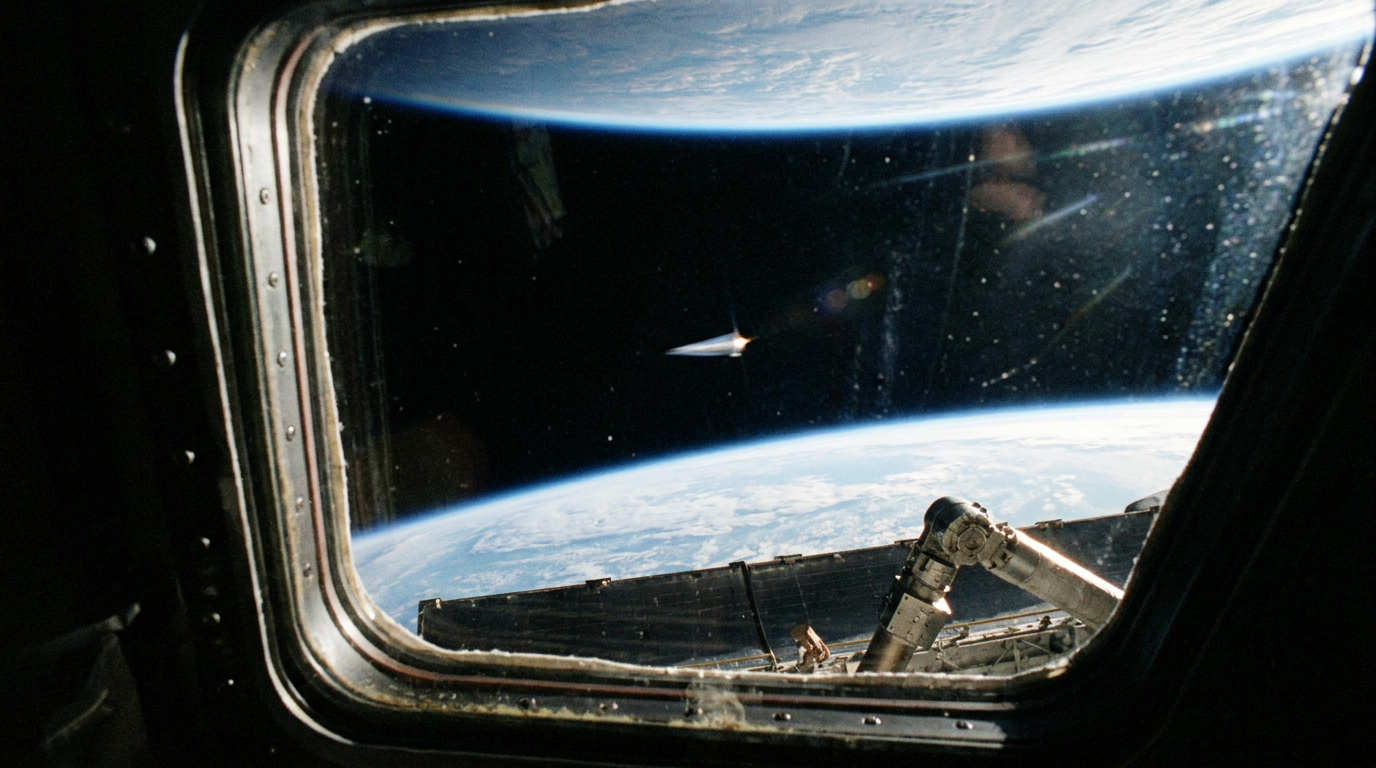
Somewhere in a NASA archive there is a strip of film, or a digital original, that would settle this in about ten minutes. It has a frame number, a time code, an exposure setting, a lens and a camera body — and somewhere adjacent to it, a crew activity log recording who was at which window when the shutter went. None of that was released.
What was released, on Friday 10 July, were three flattened image files, 3,568 by 2,245 pixels, catalogued by the Department of War as NASA-UAP-D030 and its siblings under the title STS-80 Unidentified Object Image 1, 1996. They show a small, elongated, narrow triangular shape — cone-like, depending on how you squint — hanging in black space. Between the first and second frame it has changed its orientation. In the third, Earth is behind it.
That is the entire evidentiary package. It is, depending on your temperament, either the most interesting orbital photograph the American government has ever formally conceded it cannot explain, or a picture of a bit of rubbish.
What the release actually is
PURSUE — the Presidential Unsealing and Reporting System for UAP Encounters — has been running at war.gov/ufo since 8 May, publishing historical UAP material on a rolling basis under an executive order signed earlier this year. The fourth tranche landed on 10 July and runs to 40 files: 14 documents, 19 videos, four audio files and three images. The material is drawn from the Pentagon, NASA, the CIA, the FBI and the Department of Energy.
Most of the attention went elsewhere, and reasonably so. The same batch contained nineteen infrared military videos that the All-domain Anomaly Resolution Office has formally classed as unresolved, Range Fouler debriefs from naval aviators, a Department of Energy file on a 2015 intrusion over the Pantex nuclear weapons plant, and the stenographic transcript of the 1949 Los Alamos meeting at which Edward Teller and Lincoln LaPaz failed to agree on what the green fireballs were.
The three images are the whole of NASA’s contribution to the tranche — and the first time the agency’s shuttle-era imagery has been formally entered into a government disclosure series, rather than merely circulating among researchers who dug it out of the public photo catalogues themselves.
What STS-80 was doing up there
The mission matters here, because the mundane explanations all depend on it.
Columbia launched on 19 November 1996 and came home on 7 December, logging 17 days, 15 hours and 53 minutes — the longest shuttle flight ever flown, a record that stood to the end of the programme. Kenneth Cockrell commanded, with Kent Rominger in the right seat and Tamara Jernigan, Thomas Jones and Story Musgrave as mission specialists. It was Musgrave’s sixth and final flight, making him the only person to have flown all five orbiters.
The flight profile was busy, and — importantly — it involved putting things outside and getting them back. On flight day one the crew deployed ORFEUS-SPAS II, an ultraviolet astronomy platform that spent a fortnight free-flying alongside them. On flight day four out went the Wake Shield Facility-3, a twelve-foot stainless steel disc designed to trail an ultravacuum in its wake for growing semiconductor films. Both were retrieved.
Two spacewalks were on the manifest, with Jernigan and Jones due to rehearse assembly techniques for the space station that had not yet been built. They never happened: the outer airlock hatch would not open, managers sensibly declined to force it and risk the seals, and the EVAs were struck. Post-flight teardown found the culprit — a loose screw.
So: seventeen days at around 350 kilometres, two large payloads deployed and recaptured, a payload bay repeatedly worked and vented, and an airlock cycled and pressurised for spacewalks that never took place. If you set out to design a mission that maximised the ice, frozen propellant, thermal-blanket fragments and assorted flotsam drifting within a few tens of metres of a spacecraft, you would design something quite like STS-80.
The video is not the photographs
This needs saying clearly, because thirty years of internet argument has welded the two together.
STS-80 is already famous in this subject for its video — long sequences of luminous specks drifting and apparently flashing near the orbiter, recorded by a low-light television camera in the payload bay that was being pointed and operated remotely by flight controllers in Houston. That footage has been picked over since the late 1990s and it is, by any reasonable reading, resolved.
Tom Jones, who was aboard, has reviewed it and said so in plain terms: what the camera captured was ice particles and man-made debris drifting out of the cargo bay, within a few tens of feet of the vehicle. The flashing is not a signal — it is small irregular flakes tumbling, catching sunlight on one facet and losing it on the next. Jones, a planetary scientist by training and by his own account a keen UFO enthusiast in his younger years, has been consistent about this for two decades.
James Oberg, who spent his NASA career at Johnson Space Center working shuttle operations and has made a second career of dismantling orbital UFO claims, supplies the geometry that makes it click. In orbit a spacecraft casts no visible shadow, because there is no surface for it to fall on. During orbital twilight — darkness below, sunlight still striking the vehicle — that invisible shadow becomes suddenly obvious the moment a particle drifts into it and blinks out of existence. Objects appearing from nowhere and vanishing into nothing is exactly what the physics predicts. Oberg’s coinage for the debris cloud, “space dandruff”, is unkind and accurate.
None of that analysis applies to the three stills. Different camera, different medium, different object: a single elongated triangular form photographed presumably through a flight-deck window, not a swarm of specks on a low-light TV feed. The video’s tidy explanation has been imported wholesale to cover the photographs, largely because both carry the label STS-80. That is not an argument; it is a filing error.
What the photographs will not tell you
Nor, unfortunately, are the photographs much of an argument either — and the reason is the release itself.
The published copies carry no metadata capable of revealing the time, the camera, the lens, the exposure or the focal distance. Nothing states the interval between one frame and the next — and without that interval, the change in the object’s orientation between frames one and two is uninterpretable. A rotation over four seconds and a rotation over four minutes describe wildly different things, and the file does not say which happened. Speed cannot be calculated. Trajectory cannot be reconstructed. Angular size cannot be converted into physical size, because nothing establishes range.
That last point is the whole ballgame. Without distance, an image of an unidentified object is a picture of an angle: a three-metre craft at two kilometres and a three-centimetre flake of insulation at twenty metres subtend the same angle and produce the same pixels. It is the same measurement problem the Galileo Project built an entire triangulating observatory to solve, and it is why a single monocular frame — from a shuttle window, a cockpit or a phone — cannot in principle resolve what it shows.
The frustration is that this is one of the rare cases where the missing numbers plausibly still exist. Shuttle photography was meticulously catalogued: magazines logged, frames numbered, crew activity timelined to the minute. Somebody could look up which magazine these came from, when it was exposed and where Columbia was pointing. The government published the pictures and withheld the paperwork that would make them mean something.
“Unresolved” is a filing category, not a verdict
The Department of War has been consistent, and to its credit unglamorous, about what the word means: a case is unresolved when investigators lacked sufficient information to reach a definitive explanation. It is not a statement that a case is inexplicable, and emphatically not a statement that anything has been linked to non-human activity. Every PURSUE release has said so; every third headline has ignored it.
Applied here, though, “unresolved” is close to a tautology. Strip the timing, scale and provenance out of three photographs and of course no analyst can resolve them. The category is doing no work; the redaction is. Compare a properly reported null: when four radio observatories spent nine months listening to 3I/ATLAS, the papers published hard transmitter limits in watts — numbers you can check, argue with and build on. Three undated image files and a shrug is not the same species of statement.
The precedent nobody has resolved either
There is one reason not to file the stills alongside the video and walk away, and it is called STS-48.
In September 1991, Discovery’s cameras recorded objects that appeared to change direction sharply shortly after a thruster firing. Oberg’s explanation was the familiar one: ice particles, kicked by the exhaust plume. Jack Kasher, Professor Emeritus of Physics at the University of Nebraska, disagreed in detail — arguing that the primary object paused for around half a second before accelerating, that the acceleration began roughly 1.2 seconds after the thruster fired, and that the implied geometry put any ice particle nearly two miles from the orbiter, well beyond the plume’s reach. Oberg’s response was that Kasher’s analysis, and a parallel one by Mark Carlotto, contained grievous technical flaws rooted in a misreading of the orbital environment.
Thirty-five years on, that argument has not been settled, and the people on both sides are competent. It is a standing demonstration that “it’s just debris” is a hypothesis about shuttle imagery rather than an automatic truth — extremely well supported in most cases, and occasionally contested seriously. The honest position on the STS-80 stills is that the debris hypothesis is very probably right and has not actually been tested, because the release made testing impossible.
Story Musgrave, for what it is worth, has spoken publicly over the years about seeing things from orbit he could not identify, while being scrupulous about not claiming they were anything more than that. That is roughly where the crew testimony sits: not a corroboration, not a denial, and considerably more careful than most of what has been built on top of it.
The UAP Times take
We rate this credibility 3 — Unconfirmed, and the rating is split down the middle in a way the number cannot quite express.
The provenance is not in question at all. These are authentic NASA images from a documented 1996 mission, published by the United States government under its own disclosure programme, with a catalogue number. On that narrow point the file is as solid as anything in this subject gets, and considerably more solid than the long-narrow triangular objects that usually arrive here by way of somebody’s cousin.
The interpretation is where it collapses, and our honest expectation is mundane. A mission that spent seventeen days deploying and recapturing two large payloads, venting a payload bay and cycling an airlock is a mission surrounded by debris, and the base rate for an elongated glinting object photographed near a shuttle is overwhelmingly a piece of the shuttle. If we had to bet, we would bet on insulation, ice or a fragment of something that came off ORFEUS or the Wake Shield.
But we would rather not have to bet, and that is the actual story. This is the fourth tranche of a disclosure programme whose stated purpose is to let the public see the evidence, and it published photographs with the evidentiary content surgically removed. The frame numbers exist. The mission timeline exists. The magazine logs exist. Releasing the picture and withholding the caption converts a resolvable archival question into a permanent talking point, and thirty years of experience suggests the talking point will now outlive everyone involved.
Disclosure that hands you an image and keeps the metadata is not disclosure. It is publishing.
Further reading: for why a single-camera image can never establish what it shows, see the Galileo Project’s distance problem. For the strongest historical document in the same PURSUE tranche, the 1949 Los Alamos transcript; for the most operationally alarming, the Pantex incursion file.